Pearls of wisdom
Faith, Questions, Convictions, and Lessons From a Walk With Jesus
These Pearls are personal reflections from my walk with Jesus Christ.
I am not presenting them as Scripture, prophecy, new revelation, or the words of a theologian who believes he has everything figured out. I am still learning, still growing, still being corrected, and still discovering how much of my own understanding must remain surrendered to God.
The Bible is the authority—not me.
These writings are my attempt to take the things I am learning through Scripture, prayer, life, failure, repentance, suffering, questions, and continued growth with Jesus and put them into words.
Some Pearls deal directly with the Gospel and salvation. Others explore grace, obedience, assurance, suffering, spiritual warfare, false teaching, religious tradition, discernment, predestination, peace, darkness, light, and the difficult questions Christians sometimes disagree about.
But they are all meant to return to the same center:
Jesus Christ.
My goal is not to create another theological system, build another denomination, win religious arguments, or convince anyone that agreeing with me is the measure of truth.
My goal is much simpler.
Point people toward Jesus.
And beneath all of these words, warnings, reflections, questions, and convictions is something even simpler:
I just want to see you in Heaven. Period.
That is the heart behind this page.
I do not want to win an argument and lose a soul.
I do not want to prove a point and forget why the point mattered.
I do not want religion, pride, tradition, fear, confusion, sin, false teaching, or anything else to keep someone from knowing the One who can save them.
If I speak strongly about salvation, it is because eternity matters.
If I warn about deception, it is because truth matters.
If I speak about sin, repentance, grace, judgment, or false teaching, it is not because I want to condemn people.
It is because I want people to know Jesus Christ.
I want you forgiven.
I want you reconciled to God.
I want you born again.
I want you to know the peace of Christ.
I want you to walk with Him.
And when this life is over,
I want to see you in Heaven.
Where Scripture speaks clearly, I want to stand firmly.
Where interpretation is required, I want to remain humble.
Where I am uncertain, I want to be willing to say, “I don’t know.”
And if God's Word shows me that something I believe is wrong, I want to change what I believe rather than change what Scripture says.
So read these Pearls as they are intended:
Personal reflections from one follower of Jesus to another.
Test what I say.
Compare it with Scripture.
Keep what is true.
Discard what is not.
And above everything else, do not allow my words—or anyone else's—to become more important than the One these writings are meant to point toward.
The way.
The truth.
The life.
Jesus Christ.
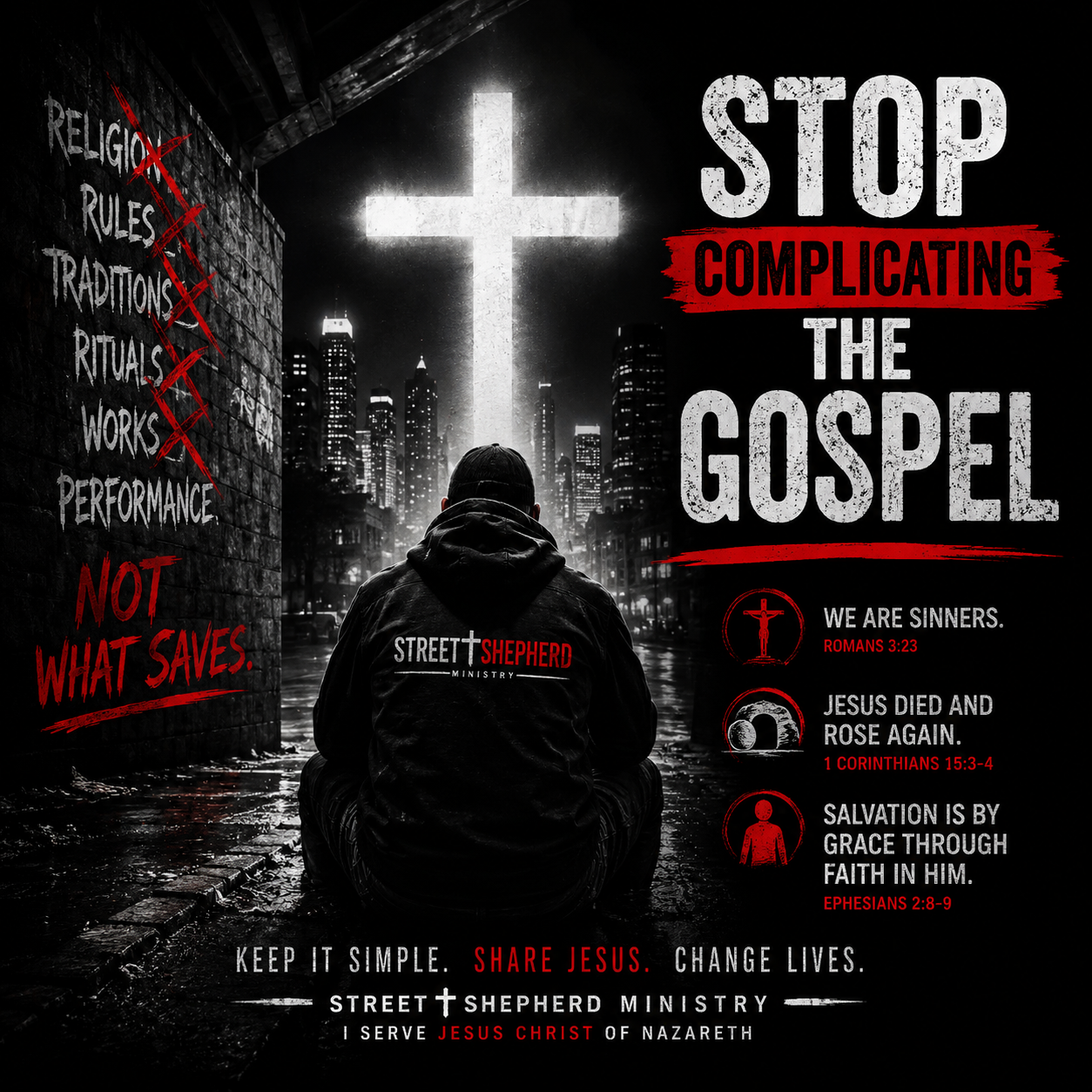
The Gospel Does Not Need to Be Complicated
A Personal Pearl on Sharing Jesus Simply
I want to begin with something I consider important:
I am not a preacher.
I am not a pastor.
I am not a theologian.
I am not a Bible scholar.
I am not a historian, linguist, or expert in religion.
I am a follower of Jesus Christ.
That does not mean I reject scholarship. I am thankful for Christians who study history, languages, manuscripts, theology, philosophy, apologetics, archaeology, and the difficult questions people ask about the Bible. Those gifts can serve the Church tremendously.
But I do not believe a person needs to become an expert in those things in order to understand the heart of the Gospel.
God did not hide salvation behind an academic maze.
The Gospel is deep enough to occupy the greatest minds for a lifetime, yet simple enough for an ordinary person with a willing heart to receive.
“I am the way, the truth, and the life. No one can come to the Father except through me.”
— John 14:6
That is where I try to keep the focus:
Jesus.
He died for our sins.
He rose from the dead.
We cannot save ourselves.
God offers salvation by grace through faith in His Son.
Through Christ we are reconciled to the Father.
Everything else may help us understand that truth more deeply, defend it more carefully, or explain it more clearly.
But nothing should become more important than the truth itself.
I Do Not Need to Win Every Argument
One reason I do not call myself an expert is that I do not believe my assignment is to win every theological argument I encounter.
Christians can spend enormous amounts of time debating word origins, historical councils, philosophical systems, denominational traditions, obscure doctrines, timelines, secondary interpretations, and questions Scripture itself does not answer in exhaustive detail.
Some of those conversations are worthwhile.
Some require serious scholarship.
Some protect the Church from error.
But sometimes the argument becomes the mission.
And when that happens, Jesus can become almost secondary.
We can become more interested in proving that our interpretation is superior than in helping someone understand the Savior.
Knowledge can serve God.
But knowledge can also feed pride if we forget why we wanted it in the first place.
“Knowledge makes us feel important, but it is love that strengthens the church.”
— 1 Corinthians 8:1
I do not want my faith to become a competition over who knows the most Greek, remembers the most verses, understands the most historical theology, or wins the most debates.
If those things help someone point people toward Christ, I thank God for them.
But the glory belongs to God, not the messenger.
Different Servants Have Different Assignments
There are Christians who can stand on a stage and debate skeptics for hours.
There are believers who can explain manuscripts, church history, Hebrew, Greek, philosophy, science, archaeology, and difficult passages with extraordinary clarity.
I admire that when it is done faithfully and humbly.
Those gifts can remove obstacles for people who genuinely have intellectual questions.
But every believer does not need the same assignment.
“There are different kinds of spiritual gifts, but the same Spirit is the source of them all.”
— 1 Corinthians 12:4
One person may defend the faith publicly.
Another may teach Scripture verse by verse.
Another may quietly talk to one person over coffee.
Another may hand someone a Bible.
Another may share his testimony.
Another may simply say:
“Jesus saved me. Let me tell you what He did.”
The method can differ.
The Savior cannot.
My Approach Is Simple
When someone is willing to talk with me about God, I do not begin by trying to overwhelm them with theology.
I usually begin with a simple question:
Do you believe God exists?
Their answer tells me where the conversation begins.
If they say no, I may ask why.
I want to listen before I answer because unbelief is not identical in every person.
One person may have intellectual objections.
Another may have been wounded by religion.
Another may never have seriously considered God.
Another may be angry at Him.
Another may simply love a life in which God has no authority over him.
I do not need to assume I already know which one I am speaking to.
But I usually return to something simple:
creation points beyond itself.
“The heavens proclaim the glory of God. The skies display his craftsmanship.”
— Psalm 19:1
“Through everything God made, they can clearly see his invisible qualities—his eternal power and divine nature.”
— Romans 1:20
Everything around us that was designed by human beings points toward a designer:
buildings,
vehicles,
clothing,
tools,
machines,
and countless other things.
Creation is obviously far greater than anything humanity has designed.
To me, the existence, order, intelligibility, beauty, and complexity of creation point naturally toward a Creator rather than toward existence ultimately explaining itself.
I do not pretend that this one observation settles every philosophical or scientific question.
It does not.
But I believe it is a reasonable doorway into a much greater question:
Why is there something rather than nothing, and why does creation bear such order?
God Is Not Part of the Creation He Made
When I speak about God as Creator, I do not imagine Him as another object somewhere inside the universe.
God is the Creator of what exists.
He is not dependent upon the universe in order to exist.
He existed before creation and is not contained by what He made.
“In the beginning God created the heavens and the earth.”
— Genesis 1:1
John opens his Gospel by teaching that the Word existed from the beginning, was with God, and was God.
I do not need to master every philosophical argument about space, time, matter, causation, or cosmology before I can believe the central point Scripture makes:
creation exists because God created.
Those deeper discussions can be useful.
They are not the Gospel.
The Heart Matters Too
There comes a point where argument alone reaches its limit.
A person can hear evidence, reject it, hear another argument, reject that, and continue forever.
That does not always mean the person is unintelligent or dishonest.
Scripture gives several reasons people reject God:
pride,
love of darkness,
hardness of heart,
spiritual blindness,
deception,
ignorance,
rebellion,
and unwillingness to come to Him.
“God’s light came into the world, but people loved the darkness more than the light, for their actions were evil.”
— John 3:19
“They know the truth about God because he has made it obvious to them.”
— Romans 1:19
Romans 1 convinces me that humanity is not as spiritually neutral as we sometimes pretend.
Creation bears witness to God, and human beings are accountable for how we respond to that witness.
But I want to be careful not to claim more than Scripture allows me to know about a particular individual.
If someone calls himself an atheist or agnostic, I do not need to accuse him of consciously lying about what is inside his mind.
God knows that heart better than I do.
What I can say is that Scripture teaches that God has not left Himself without witness and that human beings are capable of suppressing truth because they do not want God in His rightful place.
Pride is one powerful form of that rebellion.
“Pride goes before destruction, and haughtiness before a fall.”
— Proverbs 16:18
Lucifer’s fall itself reminds me of what pride does:
the creature begins looking upward at the Creator and somehow imagines that the proper order should be reversed.
Human pride can do something similar.
We want a God we can understand completely, control, reduce, redefine, or place inside a box small enough for us to judge.
But if God could fit entirely inside my mind, He would not be much of a God.
I Cannot Change a Hardened Heart
This realization also keeps me from wasting endless energy trying to force someone into belief.
I can share truth.
I can answer questions.
I can explain why I believe.
I can give evidence.
I can tell someone what Jesus has done for me.
I can pray.
But I cannot regenerate another human heart.
Only God can do that.
“No one can come to me unless the Father who sent me draws them to me.”
— John 6:44
So if someone is hostile, mocking, completely closed, and interested only in arguing, I do not believe I must spend hours fighting with him in order to prove I love him.
Jesus Himself sometimes answered questions and sometimes refused to entertain dishonest ones.
There are people who want answers.
There are people who want arguments.
I want to recognize the difference.
If someone has ears to hear, I want to speak.
If someone only wants a fight, I am willing to plant the seed I can and leave the rest with God.
If They Believe in God, I Ask About Jesus
If someone tells me that he does believe God exists, my next question is usually simple:
Who is God to you?
Is Jesus the God you believe in?
Do you follow another religion?
Do you believe in a Creator but nothing more specific?
Again, I am not asking because I want to trap the person.
I am trying to understand where he is standing so I can explain why I stand with Jesus.
Then I share the Gospel.
Not every denominational argument.
Not every church controversy.
Not every difficult doctrine.
The Gospel.
God is holy.
We have sinned.
We cannot make ourselves righteous enough to erase that guilt.
God loved us enough to send His Son.
Jesus lived without sin, died for our sins, and rose from the dead.
Salvation is offered by grace through faith in Him.
Through Christ we are reconciled to the Father.
The Holy Spirit gives new life to those who belong to Him.
Then we follow Jesus—not to purchase salvation, but because He has saved us.
Why Jesus Makes Sense to Me
When I compare the claims of Christianity with other religious systems, I keep returning to Jesus.
I do not mean that every question about Christianity is easy or that every Christian tradition is correct.
I mean that Jesus gives a complete answer to the deepest human problem.
Where did life come from?
Who is God?
What is wrong with us?
Why does evil matter?
What is justice?
What is love?
How can guilty people be forgiven without pretending evil is harmless?
How should we live?
What happens after death?
Where can lasting peace be found?
Jesus does not merely tell us to climb toward God.
He tells us that God came toward us.
The cross shows both perfect justice and perfect mercy.
Sin is not excused.
It is paid for.
The guilty are not told to pretend they are righteous.
They are offered the righteousness of Christ.
God does not lower His holiness in order to save us.
He satisfies justice through His Son and offers mercy to sinners.
That is why Jesus is not merely the religious option I happen to prefer.
I believe He is the truth.
Faith Is Not Irrational, but It Is More Than Argument
I do not believe following Jesus means turning off the mind.
Christianity makes historical claims.
The resurrection matters.
Truth matters.
Evidence matters.
Reason matters.
But nobody is argued into the Kingdom merely because another person constructed the perfect syllogism.
At some point the question becomes personal:
Will I trust Him?
A person can know enormous amounts about Christianity and never surrender to Christ.
Another person may know far less theology but genuinely understand that he is a sinner who needs Jesus.
The thief on the cross did not graduate from seminary.
He recognized the King beside him and trusted Him.
“Jesus, remember me when you come into your Kingdom.”
— Luke 23:42
“I assure you, today you will be with me in paradise.”
— Luke 23:43
There is something beautiful about that simplicity.
I Share What Saved Me
This is ultimately how I think about evangelism.
I am not trying to sell Christianity.
I am not trying to win a religious competition.
I am not trying to prove that I am smarter than the person standing in front of me.
I am sharing what I believe saved me:
Jesus Christ.
If someone wants to know more, I will share everything I can.
If I do not know something, I can say:
“I don’t know.”
If another believer understands that question better than I do, I can point the person toward someone who can help.
There is no shame in that.
My inability to answer every question does not make Jesus less true.
And another Christian’s greater knowledge does not make him a greater Savior.
We are servants.
Christ is Lord.
The Gospel Should Remain the Main Thing
I am thankful for pastors.
I am thankful for teachers.
I am thankful for scholars.
I am thankful for apologists.
I am thankful for missionaries.
I am thankful for believers who can publicly defend the faith with knowledge and courage I may never possess.
But whether someone speaks to ten thousand people or one person on a sidewalk, the purpose should remain the same:
Point them toward Jesus.
Not toward our ego.
Not toward our intelligence.
Not toward our fame.
Not toward our ministry brand.
Not toward our denomination.
Not toward our ability to win debates.
Jesus.
“He must become greater and greater, and I must become less and less.”
— John 3:30
That is the kind of evangelism I want.
Simple enough that an ordinary person can understand it.
Deep enough that a scholar can spend a lifetime studying it.
True enough that it does not need manipulation.
Powerful enough that I do not need to force anyone to believe it.
Loving enough to share.
Serious enough not to soften.
Humble enough to admit what I do not know.
And centered entirely upon the One who matters.
The way.
The truth.
The life.
Jesus Christ.
If They Have Ears, Let Them Hear
My responsibility is not to make every person believe.
My responsibility is to be faithful with the truth I have been given.
I can plant.
Someone else may water.
God gives the growth.
“It’s not important who does the planting, or who does the watering. What’s important is that God makes the seed grow.”
— 1 Corinthians 3:7
So I will share the Gospel where God opens the door.
I will answer sincere questions when I can.
I will keep learning.
I will remain thankful for believers whose gifts are different from mine.
I will not pretend to know what I do not know.
I will not turn every conversation into a debate.
I will not measure success by whether someone agrees with me immediately.
And I will not allow complicated arguments to bury the simple message that saved me.
God exists.
We need Him.
Jesus came for sinners.
He died.
He rose.
He saves those who genuinely place their faith in Him.
Follow Him.
Everything else should help us understand that truth—
not replace it.
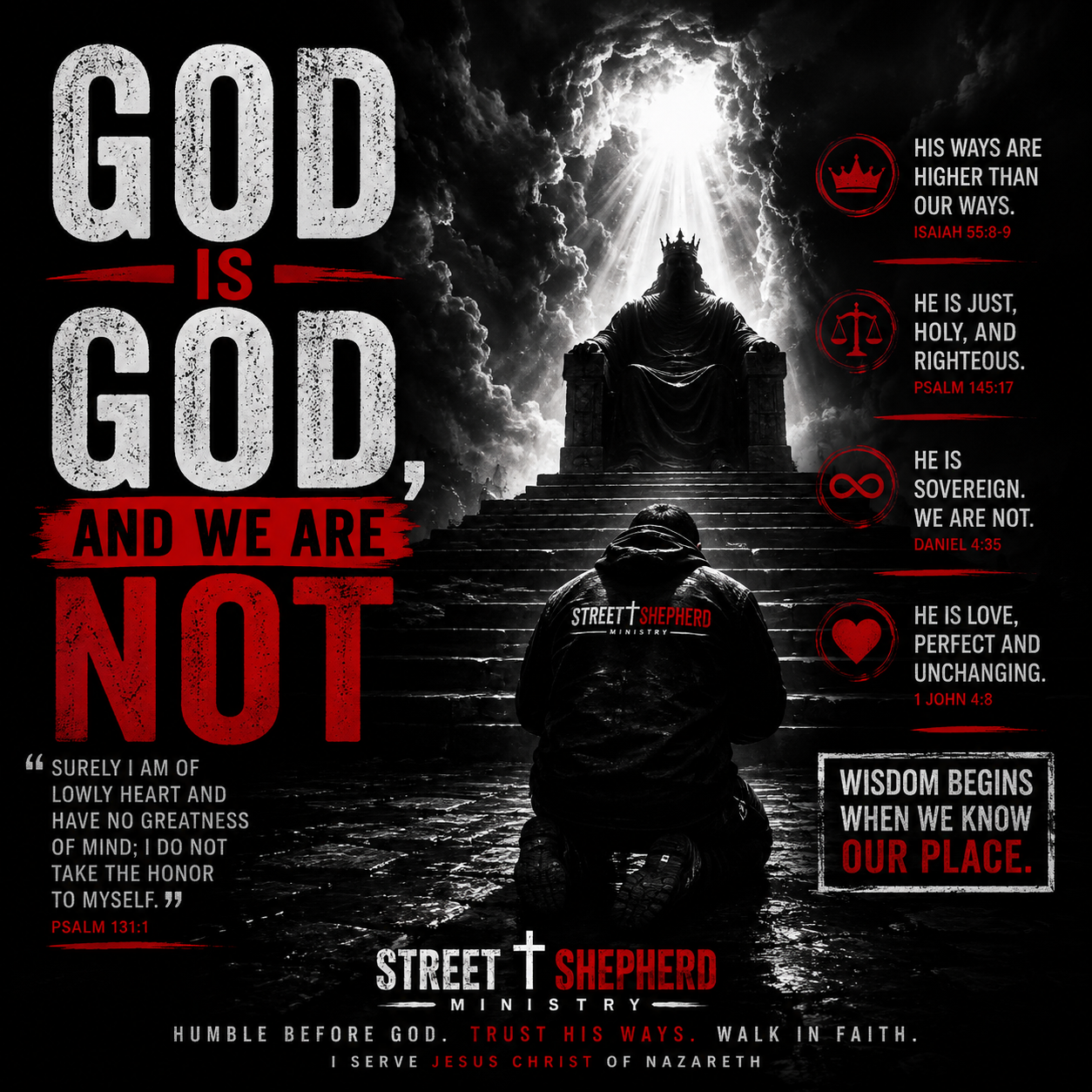
God is god, and we are not.
The beginning of wisdom is the fear of the Lord. Not the kind of fear that makes us run from God as though He were cruel, but the reverent fear that recognizes who He is. He is holy. He is eternal. He is perfectly righteous, perfectly just, perfectly loving, and completely sovereign. He is God, and we are not.
That truth must come first, because without it, we will eventually try to place God beneath our own understanding. We will judge His decisions by human standards, demand explanations as though He owes us one, and assume that if we cannot understand something, then it must be wrong.
But God is not limited by what we can understand.
We can truly know Him through Scripture, prayer, the work of the Holy Spirit, and what He chooses to reveal. We are not blind, and faith does not require ignorance. God has given us His Word so that we may know His character, understand His will, recognize His promises, and draw near to Him.
But knowing God is not the same as knowing everything God knows.
We may ask Him questions. We may grieve before Him. We may cry out, seek understanding, and honestly admit that we do not know why something has happened. Scripture is filled with faithful people doing exactly that.
But there is a difference between asking God a question and questioning the God to whom we are speaking.
One comes from humility.
The other places God on trial.
That is part of the lesson in the book of Job. Job’s suffering was not punishment for secret wickedness, as his friends falsely claimed. He was described as blameless and upright, and what happened to him involved a spiritual reality that he could not see.
But as his suffering continued, Job began pleading his case as though God needed to answer according to Job’s understanding of justice. He knew he had not committed the evil his friends accused him of, but he could not see the full picture.
When God finally answered, He did not explain every event behind Job’s suffering. He reminded Job who He was.
Where was Job when God laid the foundations of the earth? Could Job command the morning, govern creation, control the heavens, or see every hidden thing? Could he understand all that God understood?
Job’s response was humility.
He realized that he had spoken about things too wonderful for him to understand.
That lesson is not meant to stop us from seeking God. It is meant to correct the posture from which we seek Him.
We should ask as children speaking to a Father, not as judges speaking from a throne.
When we forget that distinction, life becomes harder to endure because we begin measuring God’s goodness by our circumstances. When life is peaceful, we say God is good. When suffering comes, we begin wondering whether He has failed us.
But God’s character does not change with our circumstances.
He is good when we understand Him and when we do not.
He is just when we see the reason and when the reason remains hidden.
He is faithful when He delivers us immediately and when He calls us to endure.
He is still God when our prayers are answered differently than we hoped.
This also changes the way we understand the Bible.
The Bible is not a collection of disconnected events that God reacted to as history unfolded. Its truth, purpose, and complete story were already known to God before creation.
The Father, the Son, and the Holy Spirit were present from the beginning.
Jesus was not God’s emergency response to Adam’s fall. He was not a later solution added when humanity failed. The Word was with God, the Word was God, and the Word became flesh.
Christ was always at the center.
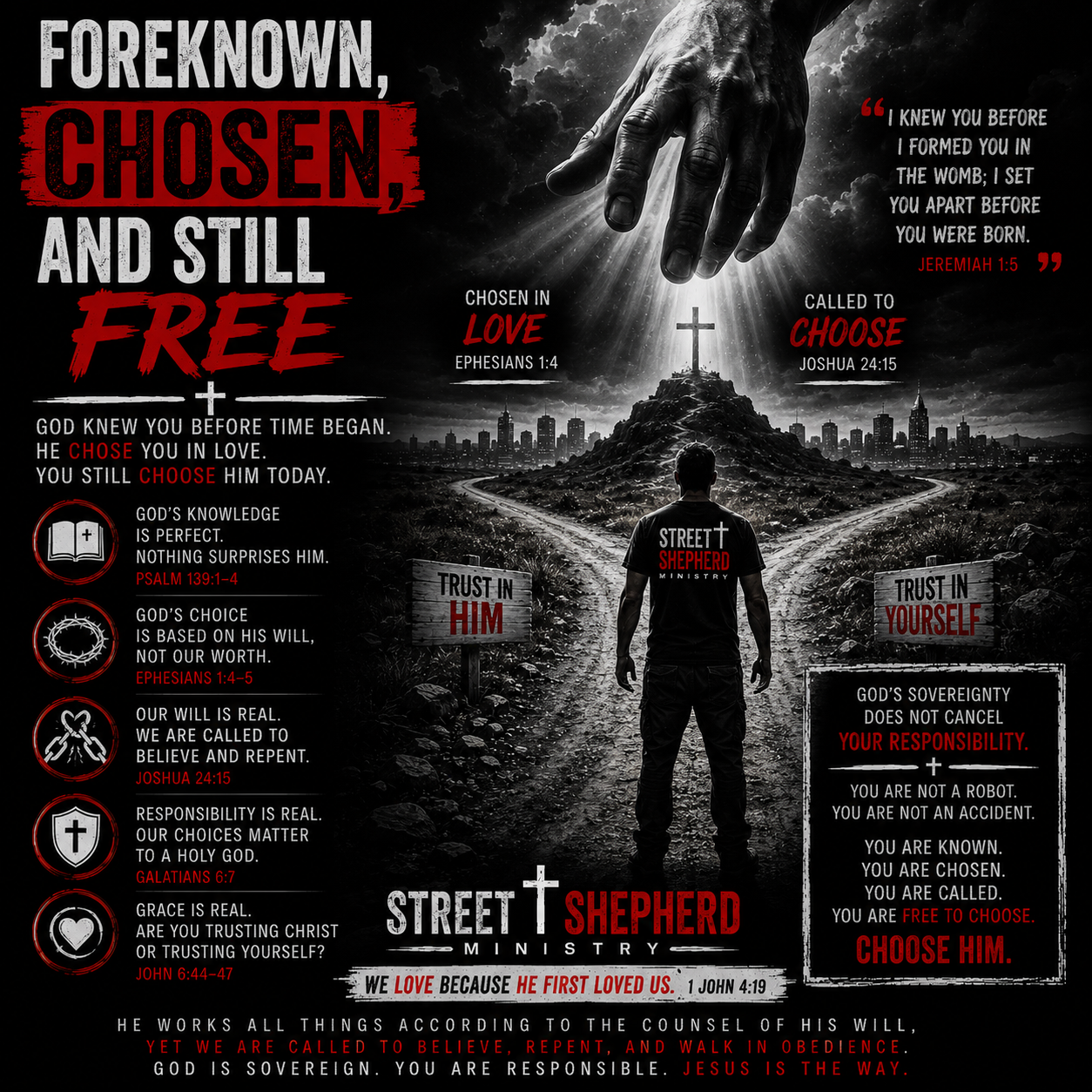
God knew creation, the fall, the covenants, the law, the prophets, the cross, the resurrection, the Church, the final judgment, and the restoration of all things before history began. Yet human choices remained real. God did not need to turn people into puppets in order to remain sovereign.
He knew every decision before it was made, and He was powerful enough to work through human obedience, rebellion, weakness, faith, and failure without ever losing control of His purpose.
When we see Scripture from that higher view, the whole Bible becomes clearer.
Creation reveals God’s design. The fall explains the need for redemption. The law reveals holiness and exposes sin. The sacrifices point toward the final sacrifice. The prophets prepare the way.
Jesus fulfills what came before. The Holy Spirit continues God’s work within His people. Revelation completes what God knew from the beginning.
It is one story, one purpose, and one God.
This is also why our faith must never rest on a preferred end-times theory.
We may hope for the rapture. We may pray to be spared from suffering. We may long for Jesus to return today. Hope is not wrong. Wanting deliverance is not weakness.
But hope in an event is not the same as faith in God.
Our faith cannot depend on whether the rapture happens before, during, or after tribulation. It cannot depend on our preferred timeline being correct. It cannot depend on escaping pain, understanding prophecy perfectly, or knowing exactly how the final events will unfold.
Our faith belongs in one place alone.
In God the Father. In Jesus Christ, our Lord and Savior, God in the flesh. In the Holy Spirit, who was present from the beginning and now dwells within those who belong to Christ. Period.
I may hope to be taken before suffering, but my faith is not in the rapture.
I may hope Jesus returns today, but my faith is not in my preferred timing.
I may study prophecy, but my salvation does not depend on mastering every detail.
I put my faith in Jesus.
If He removes me before tribulation, He is worthy. If He carries me through it, He is worthy. If He calls me to suffer, He is worthy. If He calls me to die faithfully, He is worthy.
God does not owe me an easy life in exchange for my obedience. Jesus never promised that following Him would remove every hardship. He promised that He would be with us, that He would never abandon us, and that those who endure in Him will inherit eternal life.
True faith says what Shadrach, Meshach, and Abednego said before the furnace: God is able to deliver us, but even if He does not deliver us in the way we hope, we will not bow to another god.
That is where peace begins. Not when every mystery is solved. Not when suffering disappears. Not when prophecy fits perfectly into our chart.
Peace begins when the heart finally settles this question:
Is God truly God, even when I do not understand?
If the answer is yes, everything else begins to fall into its proper place.
We take responsibility for our choices.
We repent instead of making excuses.
We trust instead of demanding.
We ask without accusing.
We endure without abandoning Christ.
We study without pretending to know everything.
We hope without turning hope into an idol.
And we worship God not only because of what He gives us, but because of who He is.
The fear of the Lord is the beginning of wisdom because it places everything in the correct order.
God is God.
We are His creation.
Jesus is Lord.
The Holy Spirit is our guide.
Scripture is truth.
Our understanding is limited.
His wisdom is not.
When that truth becomes the posture of our heart, God, Jesus, and the Holy Spirit become clearer—not because we have reduced them to something human beings can fully contain, but because we have finally stopped trying to place the infinite God inside the limits of the human mind.
We will never understand everything about God.
But we can know Him. We can trust Him. We can obey Him. We can love Him.
And we can endure to the end knowing that whatever He allows, whatever He withholds, and whatever He calls us to face, He will always remain perfectly righteous, perfectly just, perfectly loving, and completely worthy of our faith.
For He is God.
And we are not.
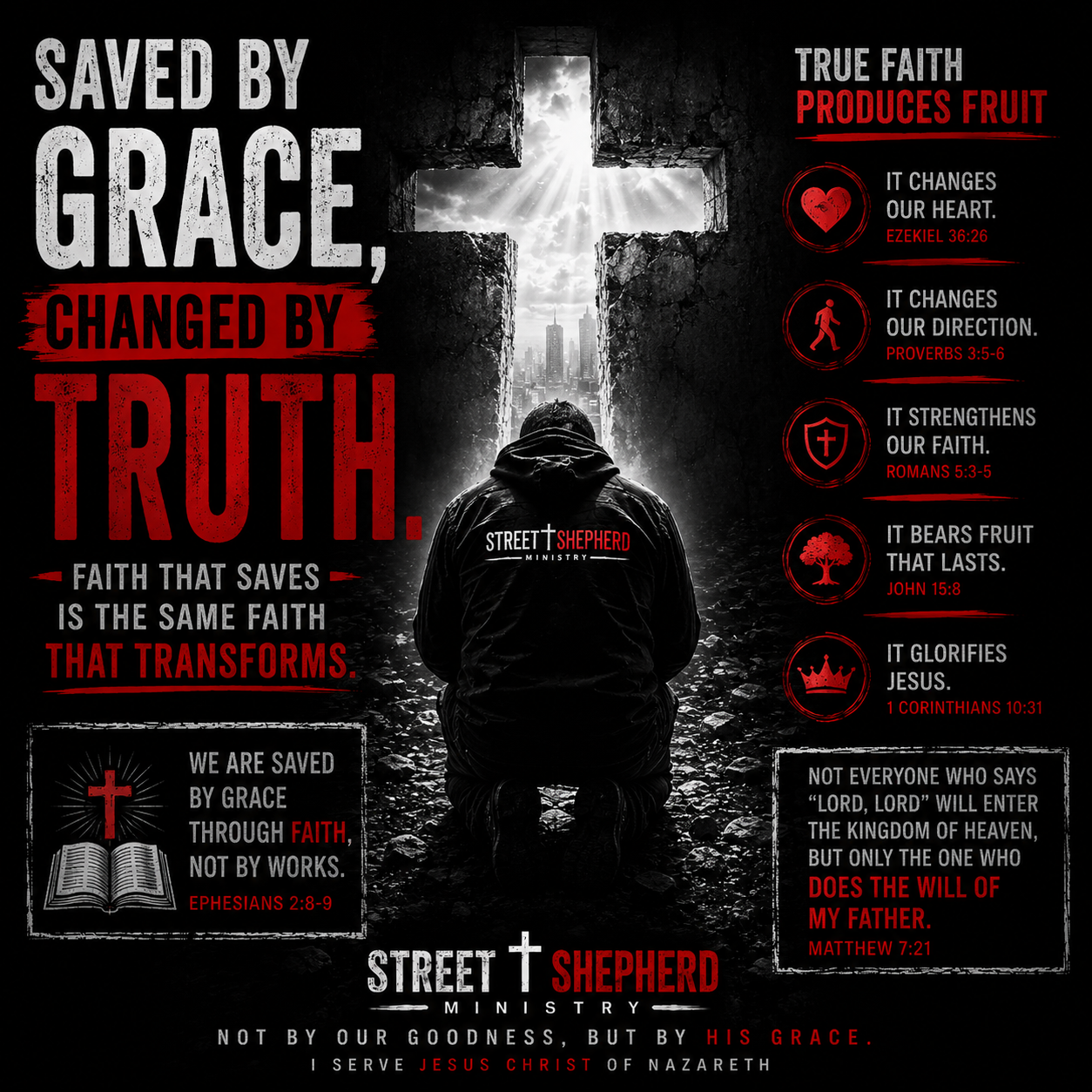
Saved by Grace, Changed by the Spirit
There is a difference between what saves us and what salvation produces in us.
That difference matters.
The Gospel is simple, but people often complicate it.
We are not saved because we are good enough.
We are not saved because we obey enough commandments.
We are not saved because we were baptized in water.
We are not saved because we belong to the right church.
We are not saved because we avoided certain sins.
We are not saved because our good deeds eventually outweighed the bad ones.
We are not saved because we remained faithful enough to earn God’s approval.
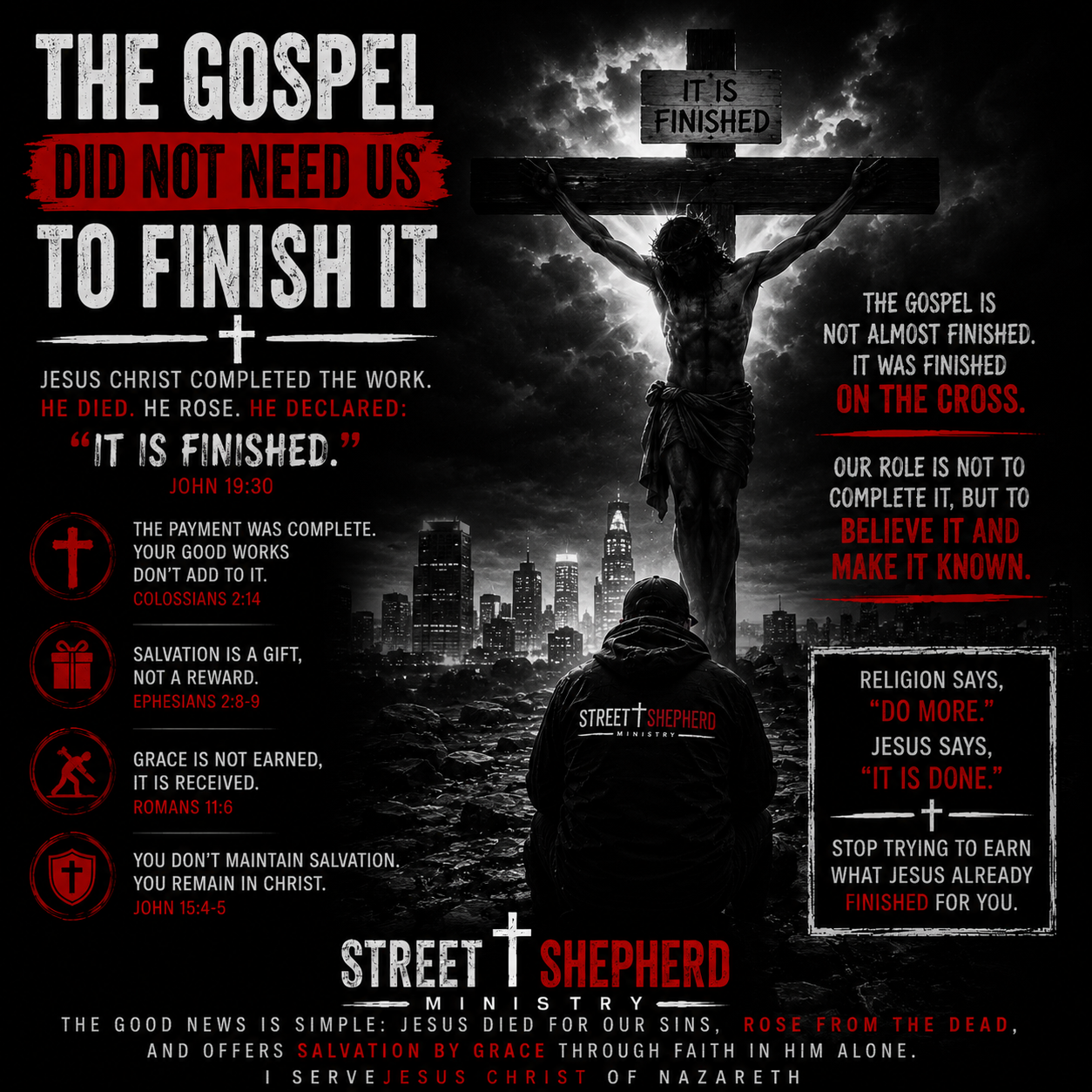
We are saved because of what Jesus Christ has already done.
“God saved you by his grace when you believed. And you can’t take credit for this; it is a gift from God. Salvation is not a reward for the good things we have done.”
— Ephesians 2:8–9
Jesus died for our sins.
Jesus paid the price we could never pay.
Jesus rose from the dead.
Salvation is received by genuinely putting our faith in Him.
Nothing else can be added to make His sacrifice more complete.
That does not mean obedience is unimportant.
It does not mean baptism is unimportant.
It does not mean repentance is unimportant.
It does not mean commandments are unimportant.
It does not mean good works are unimportant.
It means they are not the thing that saves us.
There is an order.
Grace comes first.
Faith receives it.
God justifies the sinner.
The believer is adopted into God’s family.
The Holy Spirit indwells and seals the believer.
Then fruit begins to grow.
“For we are God’s masterpiece. He has created us anew in Christ Jesus, so we can do the good things he planned for us long ago.”
— Ephesians 2:10
That verse does not contradict the two verses before it.
It completes them.
We are not saved by good works.
We are saved for good works.
A healthy tree does not become alive because fruit is hanging from its branches.
The fruit grows because the tree is already alive.
The same is true of the believer.
Our obedience does not give us spiritual life.
Spiritual life begins producing obedience.
Faith First, Fruit After
Christians sometimes say:
“Of course I believe salvation is through Jesus.”
But if you keep listening, what they really mean becomes:
Jesus plus baptism.
Jesus plus keeping enough commandments.
Jesus plus remaining sufficiently faithful.
Jesus plus sacraments.
Jesus plus avoiding particular categories of sin.
Jesus plus maintaining enough personal righteousness.
That is no longer the same claim.
“Yet we know that a person is made right with God by faith in Jesus Christ, not by obeying the law.”
— Galatians 2:16
“People are counted as righteous, not because of their work, but because of their faith in God who forgives sinners.”
— Romans 4:5
The problem is not that obedience is evil.
The problem is placing obedience where only Christ belongs.
Good works can never become a second savior.
Baptism Matters, But Jesus Saves
Jesus commands baptism.
The apostles baptized believers.
A Christian should want to publicly identify with Christ through baptism.
But water does not complete what the blood of Christ failed to accomplish.
The thief beside Jesus had no opportunity to be baptized, perform good works, join a church, take communion, or prove decades of faithfulness.
He simply turned toward Jesus in faith.
“I assure you, today you will be with me in paradise.”
— Luke 23:43
That does not make baptism meaningless.
It puts baptism in its proper place.
Baptism is obedience flowing from salvation, not payment required to purchase it.
Commandments Matter Because Jesus Matters
“If you love me, obey my commandments.”
— John 14:15
A believer should desire obedience.
We should repent.
We should surrender.
We should confess our sins.
We should resist temptation.
We should pursue holiness.
We should fear the Lord.
We should want our lives to honor Him.
But the motivation changes after salvation.
I am not obeying Jesus so that perhaps one day He will decide I have finally earned eternal life.
I obey Him because I love the One who already saved me.
There is a tremendous difference between:
“I must obey so God will save me.”
and
“God saved me, therefore I want to obey Him.”
One is trying to purchase grace.
The other is responding to grace.
Works Are Evidence, Not Payment
“Faith by itself isn’t enough. Unless it produces good deeds, it is dead and useless.”
— James 2:17
James is not contradicting Paul.
James is confronting the danger of a profession of faith that produces nothing.
Someone can claim:
“I believe.”
But if that supposed faith produces absolutely nothing—no repentance, no conviction, no transformation, no desire for God—we have reason to question whether the profession represents living faith at all.
Works therefore matter greatly.
They can be evidence of salvation.
They are not the price of salvation.
This distinction protects both sides of Scripture.
We do not become legalists who believe our behavior earns heaven.
And we do not become careless people who use grace as permission to live however we want.
The Holy Spirit changes people.
Not perfectly overnight.
Not identically.
Not without struggle.
But genuinely.
Grace Is Big Enough for the Worst Sinner
Sometimes Christians say they believe in grace until they imagine someone whose sins disgust them.
A murderer.
A violent criminal.
A prostitute.
An addict.
A gang member.
Someone who has destroyed lives.
Then suddenly grace becomes harder to accept.
Surely that person must do something first.
Surely that person must prove himself.
Surely that person’s sins were too serious for salvation to be so simple.
But that reveals something inside us.
We still want people to deserve grace.
Grace, by definition, cannot be deserved.
“Christ Jesus came into the world to save sinners—and I am the worst of them all.”
— 1 Timothy 1:15
“Some of you were once like that. But you were cleansed; you were made holy; you were made right with God.”
— 1 Corinthians 6:11
The Gospel does not say:
“Your sins were small enough for Jesus.”
The Gospel says:
“Jesus is great enough for sinners.”
If a murderer genuinely turns to Christ in faith, Jesus does not provide him with a lesser salvation.
Christ either saves sinners or He does not.
Earthly consequences may remain.
A murderer who becomes saved may still appropriately spend the rest of his earthly life in prison.
Grace removes condemnation before God.
It does not necessarily remove consequences before men.
Sin Is Serious Without Creating Different Saviors
Some sins cause greater earthly destruction than others.
Scripture recognizes different consequences, responsibilities, and judgments.
Murder is not identical in earthly consequence to an angry thought.
Adultery can destroy a family in ways another sin may not.
But before a perfectly holy God, no sinner becomes righteous because his sins happen to look smaller than someone else’s.
“For everyone has sinned; we all fall short of God’s glorious standard.”
— Romans 3:23
“For the wages of sin is death, but the free gift of God is eternal life through Christ Jesus our Lord.”
— Romans 6:23
That is why dividing people into those who are “good enough sinners” and those who are “too sinful” misunderstands the problem.
All of us need Christ.
Assurance: Adopted, Indwelt, Sealed, and Kept
One of the most beautiful parts of the Gospel is that our salvation does not ultimately rest upon our ability to remain perfect.
If it did, none of us would have hope.
Assurance is not confidence in ourselves.
It is confidence in the God who saves, adopts, indwells, seals, and keeps those who genuinely belong to Christ.
When someone truly comes to Christ, Scripture describes something far greater than a temporary religious status.
The believer is born again.
The believer is justified.
The believer is adopted into God’s family.
The believer is given eternal life.
And the believer is indwelt by the Holy Spirit.
“To all who believed him and accepted him, he gave the right to become children of God.”
— John 1:12
“You received God’s Spirit when he adopted you as his own children. Now we call him, ‘Abba, Father.’”
— Romans 8:15
“When you believed in Christ, he identified you as his own by giving you the Holy Spirit.”
— Ephesians 1:13
Paul goes on to describe the Spirit as God’s guarantee of the inheritance promised to His people.
That language matters:
Adopted.
Sealed.
Guarantee.
Inheritance.
My conviction is that genuine salvation cannot mean that God truly regenerates someone, adopts that person as His child, places His own Spirit within them, seals them for redemption, calls that Spirit a guarantee, gives them eternal life—and then later treats that saving work as though it never truly happened because the person He saved was imperfect.
The Holy Spirit is God.
He is not a temporary guest whose presence depends on our ability to achieve sinless perfection.
He does not rebel against the Father.
He does not cease to belong to God.
He does not become something other than the Holy Spirit.
Therefore, when Scripture says a genuine believer has been sealed by the Spirit for the day of redemption, I understand that sealing as real assurance grounded in God’s faithfulness, not ours.
“You were sealed for the day of redemption.”
— Ephesians 4:30
This does not mean a Christian cannot grieve the Holy Spirit.
Ephesians 4:30 explicitly warns believers not to do so.
It does not mean sin becomes harmless.
It does not mean God will not discipline His children.
It does not mean repentance, confession, obedience, or holiness become optional or meaningless.
It means those things happen inside a real relationship with God, rather than being the price paid to keep ourselves adopted.
A genuine believer can stumble.
A genuine believer can fail badly.
A genuine believer can need discipline and correction.
But the security of the believer rests in Christ’s promise and God’s keeping power, not in a fantasy that Christians suddenly become incapable of failure.
“I give them eternal life, and they will never perish. No one can snatch them away from me.”
— John 10:28
“Nothing in all creation will ever be able to separate us from the love of God that is revealed in Christ Jesus our Lord.”
— Romans 8:39
If eternal life can be received genuinely and then cease to be eternal because the believer later fails, the assurance language of Scripture becomes difficult to take at face value.
My confidence therefore is not:
“I will never fail.”
My confidence is:
“Jesus will not fail.”
Assurance Is Not Permission to Sin
This is where the doctrine of security is often misunderstood.
Someone hears that a genuine believer is secure in Christ and responds:
“Then I can live however I want.”
But that question itself misses what salvation does.
The person who has been born again has not merely received a legal escape from Hell.
God has given that person His Spirit.
The believer begins to hate what once separated him from God.
The believer begins to desire holiness.
The believer repents when he sins.
The believer increasingly wants to honor the One who saved him.
That growth may be slow.
There may be painful battles.
There may be seasons of weakness.
But genuine grace does not teach us to love sin.
It teaches us to turn from it.
“The grace of God has been revealed, bringing salvation to all people. And we are instructed to turn from godless living and sinful pleasures.”
— Titus 2:11–12
So assurance should produce:
gratitude,
worship,
repentance,
love,
and obedience—
not arrogance or carelessness.
Correct Words Do Not Automatically Mean Saving Faith
There is another danger on the opposite side.
Someone can memorize every correct theological sentence:
“Jesus is Lord.”
“Salvation is by grace.”
“We are saved through faith.”
And still not genuinely know Christ.
“Not everyone who calls out to me, ‘Lord! Lord!’ will enter the Kingdom of Heaven.”
— Matthew 7:21
Saving faith is not merely knowing the correct answer to a theological question.
It means genuinely entrusting ourselves to Christ.
There is a difference between knowing the statement:
“Jesus saves.”
and truly placing your life, guilt, hope, and eternal destiny in His hands.
“For his Spirit joins with our spirit to affirm that we are God’s children.”
— Romans 8:16
The Holy Spirit then begins confirming that relationship and producing fruit.
Therefore, repeating the correct formula for salvation does not automatically prove regeneration any more than performing impressive religious works does.
Salvation Does Not Produce Perfection Overnight
A truly saved Christian will still make mistakes.
We will misunderstand Scripture.
We will occasionally misjudge situations.
We may carry bad teaching from our past.
We may struggle with sins that take time to overcome.
We may disagree with other genuine believers.
We may need correction.
Peter needed correction.
The Corinthians needed correction.
Apollos needed greater understanding.
Being wrong does not automatically mean being unsaved.
There is a difference between an honest mistake and a false gospel.
There is a difference between immaturity and rebellion against Christ.
There is a difference between a believer struggling with obedience and someone trusting obedience instead of Christ.
Christians should learn those distinctions before casually declaring one another lost.
The Spirit Works, and We Surrender
Sanctification is not passive.
Being saved does not mean:
“Now I wait around and hopefully the Spirit makes me holy without my participation.”
Scripture tells believers to:
repent,
pray,
resist the devil,
flee temptation,
renew the mind,
put sin to death,
walk by the Spirit,
forgive,
love,
serve,
and obey.
“Work hard to show the results of your salvation, obeying God with deep reverence and fear. For God is working in you.”
— Philippians 2:12–13
Both realities exist together.
God works in us.
And we respond.
We surrender.
We choose obedience.
We repent when we fail.
We confess.
We get back up.
But none of those actions become the foundation underneath our salvation.
Christ remains the foundation.
Fear and Love Can Both Produce Obedience
There is a proper fear of the Lord.
Not merely terror.
Reverence.
A recognition that God is holy, righteous, powerful, and worthy of obedience.
But something even deeper grows alongside that reverence:
love.
The more we understand what Christ has done, the less obedience feels like paying a debt and the more it becomes an expression of love.
I do not want to honor Jesus merely because I fear punishment.
I want to honor Him because He loved me when I could not save myself.
That love produces surrender.
Not perfectly.
But increasingly.
The Order Must Never Be Reversed
This is the distinction Christians must protect:
We do not obey ourselves into salvation.
We are saved by grace through faith, and then salvation begins producing a life that wants to obey.
So remember the order:
Jesus first.
Grace first.
Faith first.
Salvation first.
Adoption and the indwelling Spirit.
Then:
repentance,
obedience,
baptism,
good works,
discipline,
service,
sanctification,
and fruit.
Those things matter tremendously.
But they must remain where Scripture places them:
on the fruit side of salvation, never on the payment side.
The moment we begin believing that our obedience completes what Jesus accomplished on the cross, we have stopped boasting in Christ and started placing confidence back in ourselves.
“Can we boast, then, that we have done anything to be accepted by God? No.”
— Romans 3:27
Salvation belongs to God.
Jesus accomplished it.
Grace offers it.
Faith receives it.
God adopts the believer.
The Holy Spirit indwells and seals the believer.
The Spirit produces fruit.
And Christ keeps those who truly belong to Him.
Works matter enormously.
But they are never the Savior.
Jesus is.
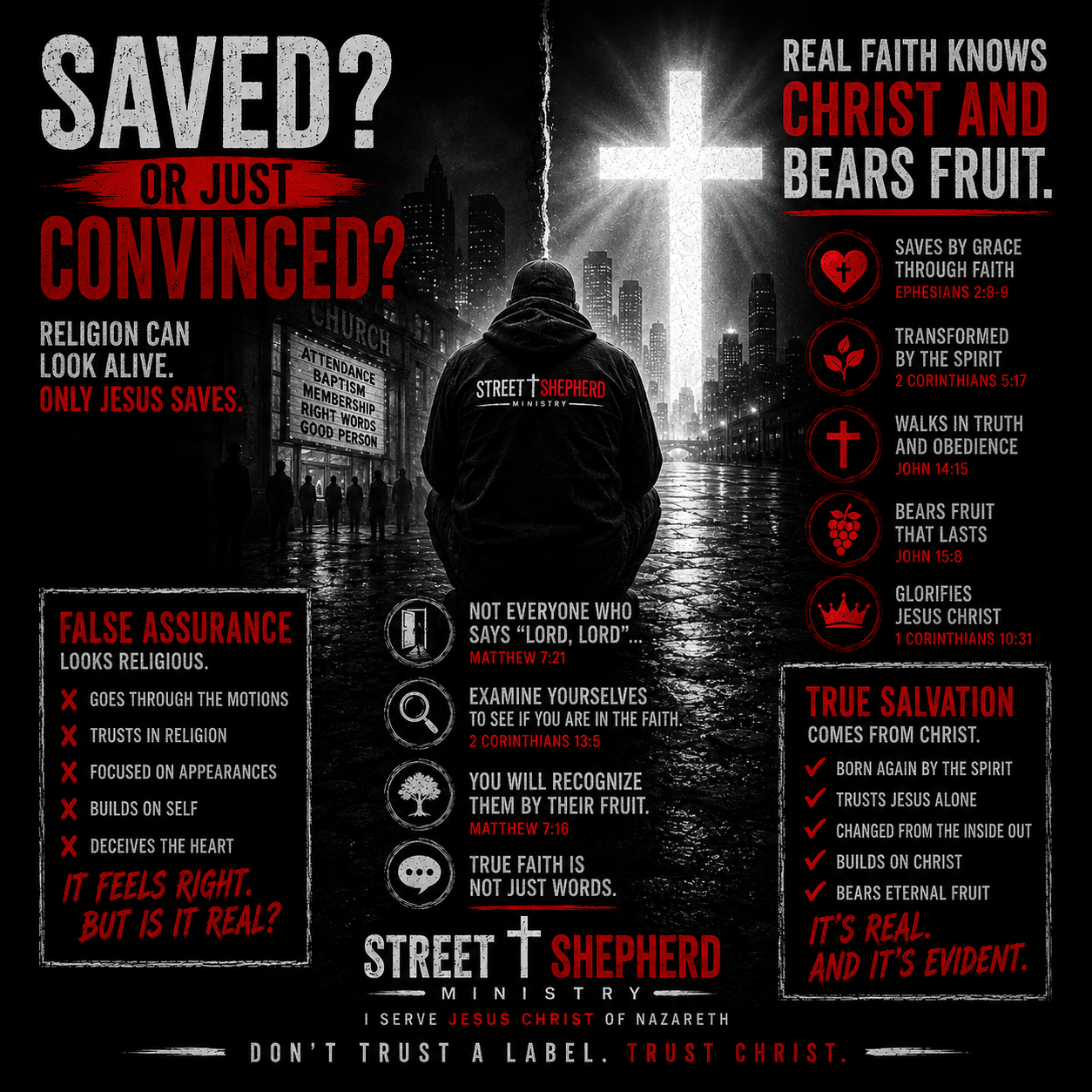
Saved—or Simply Convinced That We Are?
There may be no more comforting word in Christianity than saved.
There may also be no word used more carelessly.
People say they are saved because they attended church as children, repeated a prayer, were baptized, belong to a particular denomination, believe God exists, consider themselves good people, or once experienced a strong emotional moment.
But salvation is not a religious label. It is not membership in a church. It is not inherited through family. It is not earned through good deeds. It is not secured by a priest, denomination, sacrament, or human mediator.
And it is not proven merely because a person says, “I believe in Jesus.”
Scripture teaches that salvation comes by the grace of God through genuine faith in Jesus Christ. Jesus alone is the mediator between God and humanity. He alone bore the penalty of sin. He alone conquered death. He alone can reconcile sinners to the Father.
The question, then, is not simply whether a person calls himself saved.
The question is whether that person has truly been born again.
Jesus Is the Only Mediator
The foundation must remain clear: there is one mediator between God and mankind—Jesus Christ.
No priest can replace Him.
No saint can share His position.
No deceased believer can carry prayers to the Father more effectively than the Son.
No religious institution controls access to His grace.
Christ did not complete most of salvation and leave the remaining work to human mediators, penance, purification after death, or the prayers of those still living.
His sacrifice was sufficient.
When Jesus said, “It is finished,” He did not mean that His work would later need to be completed through purgatory.
He paid the price of sin fully.
This is one of the central problems with the doctrine of purgatory. It creates the idea that a person who dies belonging to Christ may still require a period of suffering or purification before entering the fullness of God’s presence. Prayers, sacrifices, or religious acts performed by the living may then supposedly assist that deceased person.
But Scripture does not teach us to pray deceased believers through a post-death purification process.
It teaches us to pray for people who are still alive but spiritually dead.
The Spiritually Dead
The Bible describes unsaved people as dead in sin even while they remain physically alive.
They breathe, think, work, love, speak, and make decisions, yet they lack the spiritual life that comes through Christ. They are separated from God and remain vulnerable to the second death unless they are made alive in Jesus.
These are the dead for whom we should intercede.
We pray that those who are spiritually dead will hear the gospel.
We pray that their hearts will soften.
We pray that they will repent, receive Christ, and be made alive by the Holy Spirit.
We pray while opportunity remains.
Once a person has physically died, Scripture does not describe another period of evangelism, repentance, or purification. It describes judgment.
The time to receive Jesus is not after death.
The time is now.
Every Sin Requires Jesus
This brings us to another problem: the human desire to divide sins into categories that make some appear deadly and others appear spiritually manageable.
Catholic theology uses the categories of mortal and venial sin. The system is more developed than simply saying “large sins and small sins,” but it still creates a formal distinction in which certain sins are said to destroy sanctifying grace while others damage the relationship without fully removing it.
Scripture does teach that sins differ in seriousness.
Jesus spoke of greater sin.
He taught that greater knowledge brings greater accountability.
Some actions produce far more destruction, suffering, and earthly consequence than others.
Murder is not equal in earthly harm to a careless insult.
Deliberate cruelty is not weighed the same as a thoughtless mistake.
A teacher who knowingly deceives others carries greater responsibility than a person acting in ignorance.
God judges motive, knowledge, harm, rebellion, opportunity, and the heart with perfect accuracy.
But none of this means that some sin is safe.
The wages of sin is death.
Every sin reveals our fallen condition.
Every sin requires forgiveness.
Every sinner requires Jesus.
No person becomes righteous before God by comparing his sins with someone else’s.
The liar cannot justify himself because he is not a murderer.
The greedy cannot excuse themselves by pointing toward the sexually immoral.
The unforgiving cannot claim innocence because they have never committed adultery.
The proud cannot declare themselves clean because society approves of their particular rebellion.
There may be different degrees of judgment, but there are not different saviors.
Every sin must be answered by the blood of Christ.
The Sin We Condemn and the Sin We Excuse
Christians and churches often make the mistake of choosing certain sins for public condemnation while overlooking the sins that are common, respectable, or hidden within their own communities.
Homosexual conduct, abortion, and murder may be condemned loudly, while lying, greed, gossip, racism, hatred, pride, exploitation, adultery, unforgiveness, and religious hypocrisy receive far less attention.
This creates the false impression that certain people are uniquely sinful while everyone else is basically acceptable.
That is not the gospel.
The gospel does not say some groups need Jesus while respectable sinners need only minor improvement.
We all need Jesus.
No sin is beyond His forgiveness when there is genuine repentance and faith.
A murderer can be forgiven.
A liar can be forgiven.
A person guilty of sexual immorality can be forgiven.
A person who participated in an abortion can be forgiven.
A racist can be forgiven.
A proud religious hypocrite can be forgiven.
The cross is sufficient for every repentant sinner.
But forgiveness should never be confused with God approving of what required Christ’s death.
Grace does not rename sin.
Grace does not make rebellion harmless.
Grace does not allow us to condemn one sinner while making peace with the sins we prefer.
Truth requires that we call sin what God calls it.
Love requires that we remember every sinner is offered the same Savior.
The Thief on the Cross
The thief beside Jesus is one of the clearest displays of God’s mercy.
He had no opportunity to repair his life.
He could not return stolen property.
He could not spend years demonstrating spiritual fruit.
He could not be baptized, join a church, serve the poor, or prove himself through a long process of sanctification.
He turned to Jesus in sincere faith at the end of his life, and Jesus promised that he would be with Him in paradise.
That account proves that salvation is by grace.
It proves that no lifetime is too ruined and no hour is too late when repentance is genuine.
But the thief’s story is not permission to calculate rebellion.
It does not teach that a person may reject Christ for an entire lifetime, deliberately indulge sin, and then manipulate God with a few words moments before death.
God sees the heart.
He knows the difference between genuine repentance and an attempted loophole.
The thief was not exploiting grace. He was surrendering to Christ with the only moments he had left.
Those who still have years ahead of them should not use his final-hour mercy as an excuse to resist God today.
Grace Does Not Mean Permission
Salvation is not earned through moral improvement.
We do not clean ourselves first and then approach Jesus as though we have become worthy.
We come to Him guilty, unable to save ourselves, and dependent entirely upon grace.
But the grace that saves also begins changing the person who receives it.
Being born again does not produce instant perfection. Christians still struggle. They fall, confess, repent, experience discipline, and sometimes repeat battles they wish had already ended.
Sanctification is a process.
It may be slow.
It may involve painful correction.
It may expose areas of darkness that were hidden for years.
But a person who has received the Holy Spirit cannot remain indefinitely identical to the person he was before Christ.
The issue is not whether a Christian ever sins again.
Every Christian does.
The issue is the person’s relationship with that sin.
A believer may fall into sin, but he cannot remain completely at peace with it.
He may struggle, but he cannot honestly declare that God approves of what God has condemned.
He may resist conviction for a period, but the Holy Spirit will not comfortably join him in lifelong rebellion.
He may stumble many times, but his direction begins changing.
He confesses.
He grieves.
He fights.
He returns.
He learns obedience.
He begins producing fruit.
The evidence may be imperfect, but new life is not without evidence.
The Real Problem With the Word “Saved”
This may be the deepest problem of all.
Many people who call themselves saved may never have been born again.
They may possess Christian language without possessing Christ.
They may have repeated a prayer without surrender.
They may believe facts about Jesus without placing their faith in Him.
They may want forgiveness without repentance, heaven without holiness, and a Savior who never becomes Lord.
This is why sin can be treated so lightly.
When salvation is reduced to saying the correct words once, any expectation of transformation begins to sound like legalism. Repentance becomes optional. Obedience becomes unnecessary. Sanctification becomes an extra benefit for unusually committed Christians.
But Jesus did not describe salvation as adding a religious label to an unchanged life.
He spoke of new birth.
Paul described becoming a new creation.
The apostles repeatedly taught that genuine faith produces fruit.
That fruit does not purchase salvation. It reveals that salvation has occurred.
We are not saved by works.
But a faith that never produces any change, repentance, conviction, love, obedience, or desire for Christ should not be assumed genuine merely because the person uses the word saved.
A tree is known by its fruit.
That does not authorize us to know every person’s heart or announce with certainty who belongs to God. Only God knows perfectly.
But it does mean Scripture gives us standards for examining ourselves.
Do I merely claim Christ, or do I trust Him?
Do I defend my sin, or do I bring it into the light?
Do I feel entitled to grace, or amazed by it?
Do I desire God, or only fear punishment?
Do I want Jesus as Lord, or merely as protection from hell?
Do I see any evidence that the Holy Spirit is correcting, shaping, and changing me?
These questions are not meant to destroy assurance in sincere believers who struggle.
They are meant to confront false assurance in people who have never surrendered.
Once Saved, Always Saved
I believe that those who are truly saved are secure in Jesus Christ.
No enemy can snatch them from His hand.
No earthly power can cancel His promise.
No demon can steal a soul that belongs to Him.
Nothing in creation can separate God’s children from His love in Christ.
The Holy Spirit seals those who have truly been born again.
But eternal security must not be reduced to:
“I said a prayer once, so nothing afterward matters.”
That is not security in Christ.
That is confidence in a past statement.
The better understanding is this:
Those whom Christ truly saves, Christ truly keeps.
A genuine believer can wander.
A genuine believer can fall seriously.
A genuine believer can resist correction, lose fellowship, damage his witness, fail to complete opportunities God placed before him, and suffer severe discipline.
But God does not casually abandon His children.
He corrects them.
He convicts them.
He pursues them.
He may allow painful consequences.
And Scripture suggests that, in exceptional situations, God may even end a believer’s physical life under severe discipline rather than permit continued destruction.
Paul spoke of believers becoming weak, sick, and even dying after treating the Lord’s Supper wickedly.
He also spoke of an immoral man being handed over for the destruction of the flesh so that his spirit might be saved.
These passages show that physical judgment and final condemnation are not necessarily identical.
God may discipline those who belong to Him severely.
But we must not turn that possibility into a universal doctrine or claim to know why any individual died.
God has not given us authority to make such judgments.
Can a Believer Walk Away?
The most difficult question is whether a person who was truly born again can permanently reject Christ.
Scripture contains serious warnings about apostasy, endurance, false faith, and falling away. Christians disagree on how those passages relate to eternal security.
My present understanding is that a person who is truly reborn will ultimately be preserved by God, even if he wanders deeply for a time.
When someone permanently abandons Christ, embraces unbelief, and never returns, that may reveal that the original profession was never genuine.
The person may have known Christian teaching.
He may have attended church.
He may have experienced emotion, conviction, fellowship, or spiritual influence.
But knowing about Christ and being born again are not necessarily the same.
This is why the label saved cannot settle the issue by itself.
Some people who fear losing salvation may actually demonstrate sincere faith because they grieve their sin, desire God, and long to remain with Christ.
Others may have absolute confidence while showing no repentance, transformation, love, or spiritual life.
Confidence alone proves nothing.
The foundation of assurance is Christ, and the evidence of new birth is the continuing work of the Holy Spirit.
Blasphemy Against the Holy Spirit
Jesus identified blasphemy against the Holy Spirit as the unforgivable sin.
This should not be understood merely as a struggling Christian committing a terrible act, doubting, or wandering for a time.
In its biblical setting, religious leaders witnessed the work of God through Jesus and deliberately attributed the Spirit’s work to Satan.
It reflects deep, knowing, hardened opposition to the Holy Spirit’s testimony concerning Christ.
A believer who fears that he may have committed this sin and longs to return to God is showing a posture very different from hardened rejection.
The unforgivable nature of the sin is not because Christ’s sacrifice lacks power. It is because the person rejects and slanders the very Spirit who testifies of Christ and leads sinners to repentance.
If someone permanently refuses the only Savior, there is no other sacrifice that can save him.
Salvation and Rewards
Salvation and heavenly rewards should not be confused.
Salvation is a gift of grace.
Rewards relate to what believers faithfully do after being saved.
Paul taught that every believer’s work will be tested. Some work will remain and receive reward. Other work will burn away.
A person may suffer loss while still being saved.
This means a believer can waste opportunities, ignore his calling, live selfishly, and arrive before Christ with little lasting fruit.
His lack of reward does not mean he could have purchased salvation through better performance.
It means salvation was never the reward for his works in the first place.
Jesus purchased salvation.
Our works reveal faithfulness and carry eternal consequences, but they do not add to the cross.
This gives purpose to the Christian life.
We are not working to persuade God to save us.
We work because He has saved us.
We serve because we love Him.
We obey because He is Lord.
We pursue holiness because the Holy Spirit lives within us.
We store treasure in heaven because this temporary world is not our final home.
What Purgatory Cannot Accomplish
Purgatory attempts to provide a solution after death for remaining impurity.
But the biblical answer is not post-death purification.
It is Christ.
Believers are justified through Him.
They are sanctified throughout earthly life by the Holy Spirit.
They are finally glorified by God.
The cross is sufficient for guilt.
The Holy Spirit is sufficient for sanctification.
God is sufficient to complete what He began.
No deceased believer needs the living to add payment to Christ’s finished work.
No sinner should delay repentance expecting another opportunity after death.
No religious institution controls the grace that belongs to Jesus.
The spiritually dead need our prayers now.
They need the gospel now.
They need Jesus now.
The Balanced Truth
We should not cherry-pick sins.
We should not rank ourselves above others.
We should not soften what God calls sin.
We should not pretend every sin causes identical harm.
We should not use grace as permission to rebel.
We should not use sanctification as though it earns salvation.
We should not assume that everyone who says “I am saved” has been born again.
We should not condemn every struggling believer because growth is slow.
We should not offer false assurance to someone whose life shows no evidence of repentance or spiritual life.
Every sinner can be forgiven.
Every sin requires Jesus.
No human mediator can replace Him.
No post-death suffering can improve upon His sacrifice.
No religious label can substitute for new birth.
No genuine believer should expect perfection overnight.
And no genuine conversion should be expected to produce nothing.
The narrow path is not walked perfectly, but it is walked.
A believer may stumble on it.
He may fall.
He may require help.
He may become wounded, tired, distracted, or temporarily lost from view.
But the Shepherd does not abandon His sheep.
He calls them.
He corrects them.
He carries them.
He brings them back.
The question is not whether we have ever sinned after claiming Christ.
The question is whether Christ has truly become our Lord, whether the Holy Spirit is making us alive, and whether our faith is producing the evidence of new birth.
Salvation is not a license to remain dead.
It is the gift of new life.
And where there is new life, there will eventually be signs that the person is alive.
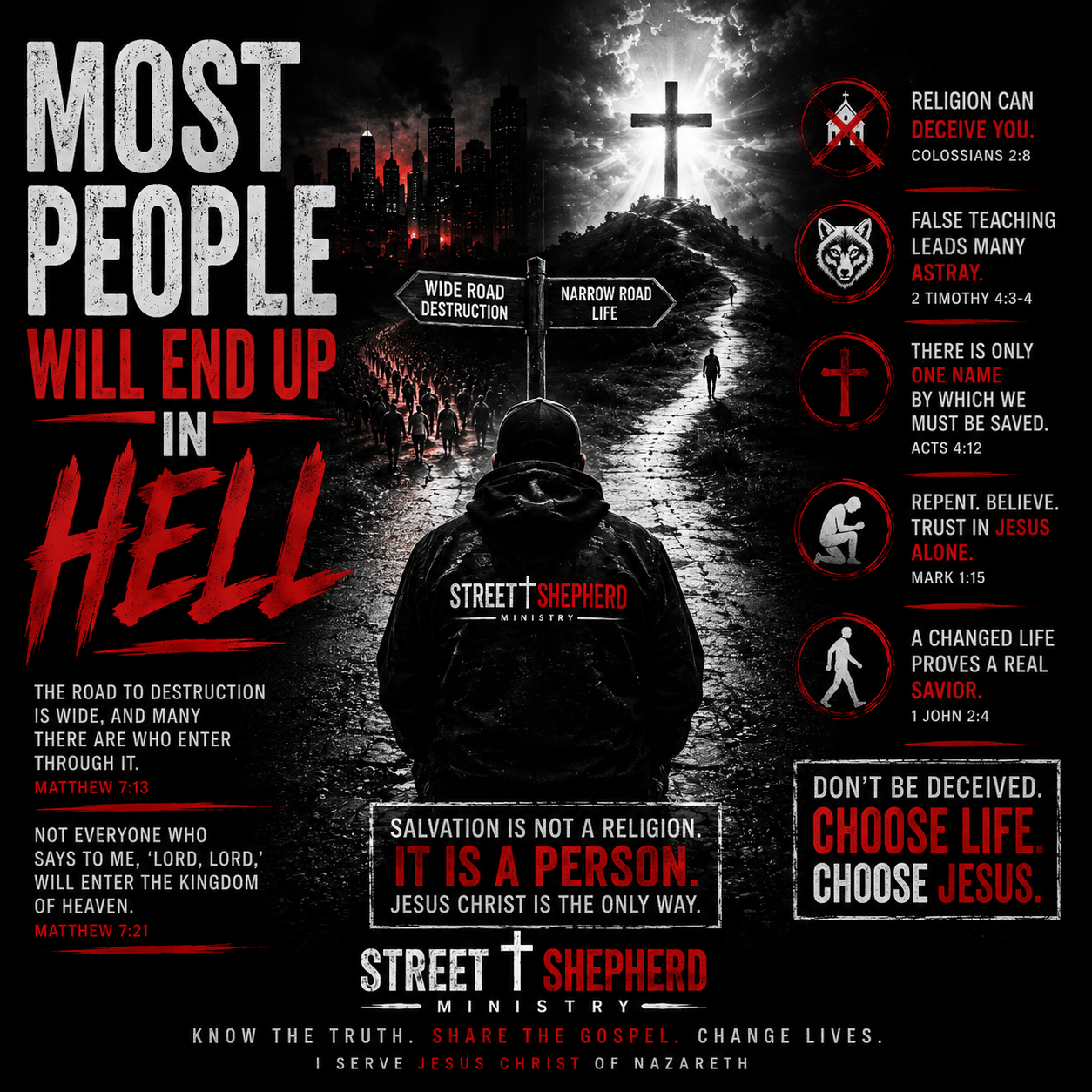
Most People Will End Up in Hell
I do not claim to know the exact number or percentage of people who will finally enter heaven or hell. That knowledge belongs to God alone.
But I cannot ignore the words of Jesus.
He described the road leading to destruction as broad and traveled by many, while the road leading to life is narrow and found by few.
That leads me to a painful conclusion:
Most people will end up in hell.
Not only murderers.
Not only rapists.
Not only violent criminals, dictators, abusers, and people who openly devote themselves to evil.
Hell will also be filled with ordinary people.
Respectable people.
Kind neighbors.
Loving parents.
Reliable coworkers.
Generous friends.
Religious people.
Churchgoing people.
People who believed in their hearts that they were good.
People who fully expected to enter heaven.
That may be the most frightening part of all.
The greatest danger is not always knowing that you are lost.
The greatest danger may be believing that you are safe when you are not.
Hell Is Not Only for the Worst People
The world has created a false picture of judgment.
People imagine heaven as the natural destination for anyone who was generally decent, while hell is reserved for the worst human beings who ever lived.
According to that standard, nearly everyone considers himself safe.
A person may lie, lust, curse, live in sexual immorality, hold bitterness, worship money, become drunk, neglect God, reject Jesus, and live entirely for himself—but still believe he deserves heaven because he never murdered anyone.
That is not God’s standard.
God does not compare you with the most evil person you can imagine.
He does not grade humanity on a curve.
The liar does not become righteous because another person is a thief.
The thief does not become righteous because another person is a murderer.
The adulterer does not become righteous because someone else committed a more violent sin.
The standard is not whether you are better than someone else.
The standard is the holiness of God.
By that standard, none of us is good.
Scripture says that no one is righteous—not even one. All have sinned and fallen short of the glory of God.
That includes me.
That includes you.
That includes the nicest person you know.
Human Goodness Cannot Save
Most people believe they are good because they use a human definition of goodness.
They say:
“I love my family.”
“I help people.”
“I have never killed anyone.”
“I give to charity.”
“I try not to judge.”
“I believe in treating people well.”
“I am better than many religious people I have met.”
Those things may have real value in this life. Kindness is better than cruelty. Honesty is better than deception. Generosity is better than greed.
But none of those things erases sin.
Good deeds cannot pay for guilt.
You cannot undo yesterday’s lie by helping someone today.
You cannot erase lust through generosity.
You cannot remove pride through church attendance.
You cannot cancel rebellion by comparing yourself with someone worse.
The problem is not only that we sometimes do bad things.
The problem is that sin lives within the human heart.
We have all chosen ourselves over God.
We have all violated His commands.
We have all failed to love Him with all our heart, soul, mind, and strength.
We have all needed mercy.
If human goodness were enough to save us, Jesus would not have needed to die.
The cross proves that our condition was far more serious than most people are willing to admit.
Religion Can Give False Assurance
One of the most dangerous forms of deception is religion without rebirth.
Religion can teach people how to appear close to God without truly knowing Him.
It can give someone rituals, traditions, prayers, titles, clothing, ceremonies, buildings, membership, religious language, and confidence about eternity while leaving the heart unchanged.
A person may attend church every week and still not know Jesus.
A person may memorize Scripture and still not know Jesus.
A person may preach, teach, sing, serve, give money, perform ceremonies, and speak constantly about God while never surrendering to Christ.
Religious activity is not the same as salvation.
Belonging to a denomination does not save.
Being baptized does not save a heart that refuses Christ.
Repeating prayers does not save.
Trusting a religious leader does not save.
Trusting rituals does not save.
Trusting your family’s faith does not save.
Trusting your own sincerity does not save.
Only Jesus Christ saves.
Religion becomes deadly when it convinces a person that he already belongs to God while his faith rests in something other than Jesus.
False assurance may be more dangerous than open unbelief because the openly lost person may eventually recognize his need.
The religiously deceived person may never search for salvation because he believes he already possesses it.
“Lord, Lord”
Jesus gave one of His most frightening warnings to people who appeared religious.
They called Him “Lord.”
They spoke about things they had done in His name.
They expected to be received.
But Jesus told them:
“I never knew you.”
They were not surprised that Jesus existed.
They were surprised that they did not belong to Him.
They knew His name.
They used His name.
They may have spoken passionately about His name.
But they did not truly know Him.
This should terrify anyone whose confidence rests only in a religious experience, a prayer repeated years ago, a church membership, a baptism certificate, Bible knowledge, ministry work, or the belief that he is better than most people.
The question is not merely:
“Do you believe Jesus exists?”
Even demons know that.
The question is:
Does Jesus know you?
Have you been born again?
Have you repented?
Is your faith in Christ alone?
Is He truly your Lord, or have you attached His name to a life that you still control?
Saving Faith Produces Change
Salvation is not earned through good works.
We are saved by grace through faith in Jesus Christ.
But real salvation does not leave a person exactly as he was.
The Holy Spirit produces change.
That change may not happen all at once.
Some sins may fall away quickly.
Others may become long and painful battles.
A true believer may stumble, fail, become discouraged, and need repeated correction.
But the direction changes.
There is a difference between struggling against sin and protecting it.
There is a difference between falling and deciding never to stand again.
There is a difference between saying:
“Lord, I hate this sin. Help me overcome it.”
And saying:
“I know what You commanded, but I have decided You have no authority over this part of my life.”
The first is weakness seeking mercy.
The second is rebellion demanding permission.
A person is not saved because he successfully removes every sin from his life.
But someone who has been born again cannot remain completely comfortable with everything Jesus died to save him from.
The Holy Spirit convicts.
He corrects.
He disciplines.
He produces fruit.
Where there is never repentance, never conviction, never change, never obedience, and no desire for Jesus to rule, a person should not comfort himself with empty words.
He should examine whether he has truly been saved.
Jesus Does Not Ask for Part of Your Life
Jesus does not ask to become one interest among many.
He does not ask for Sunday morning while the world controls the rest of the week.
He does not ask for religious words while money, sex, comfort, popularity, pleasure, power, bitterness, sports, politics, relationships, or ambition remain upon the throne.
Jesus does not negotiate for a small portion of your heart.
He commands you to follow Him.
He tells you to deny yourself.
He tells you to take up your cross.
He tells you to count the cost.
He tells you to love Him above father, mother, spouse, children, possessions, reputation, comfort, and even your own life.
These are not suggestions from a motivational speaker.
They are commands from God.
That does not mean every possession, relationship, hobby, career, or pleasure is automatically sinful.
It means none of them may stand above Jesus.
Anything you refuse to surrender can become an idol.
Money can become an idol.
Sex can become an idol.
Marriage can become an idol.
Children can become idols.
Alcohol can become an idol.
Entertainment can become an idol.
Power can become an idol.
Sports can become an idol.
Politics can become an idol.
Even religion can become an idol.
Whatever you obey above Jesus has taken a place it does not deserve.
Grace Does Not Make Sin Acceptable
Jesus did not die so that we could treat sin casually.
Grace is not permission to remain unchanged.
Grace forgives sin.
It does not rename sin as good.
Drunkenness does not become acceptable because salvation is by grace.
Sexual immorality does not become acceptable.
Lying does not become acceptable.
Greed does not become acceptable.
Pride does not become acceptable.
Hatred, bitterness, unforgiveness, filthy speech, cruelty, idolatry, and deliberate rebellion do not become acceptable.
A Christian may struggle with any of these things.
But a Christian cannot honestly say:
“Jesus is my Lord, but I refuse to let Him correct me.”
The issue is not perfection.
The issue is lordship.
Who rules your life?
Do you fall and repent, or do you defend what God condemns?
Do you ask Jesus to change you, or do you demand that He accept the life you refuse to surrender?
Following Jesus Will Cost You
Following Jesus may cost you everything the world taught you to value.
It may cost relationships.
It may cost approval.
It may cost opportunities.
It may cost money.
It may cost comfort.
It may cost habits you love.
It may cost the identity you built for yourself.
It may require you to confess what you have hidden.
It may require you to forgive someone you hate.
It may require you to leave a relationship that dishonors God.
It may require you to walk away from drunkenness, sexual immorality, greed, pride, dishonesty, or a pursuit that has become your god.
In some parts of the world, following Jesus may cost freedom or physical life.
Jesus never concealed the cost.
He told people to count it.
But salvation is not purchased by the things we surrender.
Jesus already paid the price.
The cost of discipleship is not payment for grace. It is the surrender that comes when we finally recognize that Jesus is worth more than everything we are being asked to leave behind.
What does the world offer that compares with Him?
Temporary pleasure?
Temporary wealth?
Temporary approval?
Temporary comfort?
What good is gaining the whole world if you lose your soul?
Jesus offers forgiveness.
Peace with God.
The Holy Spirit.
A new heart.
Freedom from condemnation.
Adoption into God’s family.
Resurrection.
Eternal life.
The presence of God forever.
Whatever following Jesus costs, He is worth it.
Pain Does Not Make God Guilty
Some people reject God because of what they have suffered.
They have experienced abuse, betrayal, poverty, illness, loss, hypocrisy, injustice, or cruelty.
Those wounds are real.
They should not be dismissed.
But human evil does not make God evil.
A corrupt church does not make Jesus corrupt.
An abusive parent does not make the heavenly Father abusive.
A dishonest preacher does not make the gospel false.
A painful life does not remove God from His throne.
We must also have the honesty to admit that some of our suffering is connected to our own choices.
Not all suffering is self-caused. Scripture makes that clear.
But sometimes we blame God for consequences created by our pride, addiction, dishonesty, bitterness, lust, violence, greed, laziness, or refusal to listen.
Pain may explain why someone struggles to trust.
It does not make untruth become truth.
Your wounds deserve compassion, but they do not place God beneath your judgment.
And when your own choices helped create your circumstances, healing begins with honesty and repentance—not with accusing God.
Ignorance and Hardness Are Not the Same
Not every person who questions Christianity has a hardened heart.
Some people are ignorant.
Some have been taught falsely.
Some have been wounded.
Some are honestly confused.
Some have never heard the gospel explained clearly.
They need patience, truth, compassion, and reason.
But an ignorant heart is different from a hardened heart.
A person asking sincere questions is different from someone who has decided beforehand that no answer will ever be accepted.
A misguided belief is different from deliberate refusal.
A wounded person seeking truth is different from someone who mocks what he understands and rejects God because he will not surrender.
Jesus was patient with weakness.
He answered sincere questions.
He showed compassion to the lost.
But He also spoke severely to pride, hypocrisy, hard-heartedness, and deliberate rejection.
We should do the same.
I will explain the gospel.
I will answer sincere questions.
I will reason with someone willing to listen.
I will correct misunderstandings and patiently discuss honest objections.
But I will not participate endlessly in arguments with someone who is not searching for truth.
There comes a point when a conversation is no longer about evidence.
It becomes a battle of wills.
At that point, continuing may only produce pride, anger, mockery, and sin.
Jesus told His messengers that when people knowingly refused their message, they were permitted to leave and shake the dust from their feet.
There is a time to speak.
There is a time to warn.
And there is a time to walk away and pray.
Walking away from a hardened argument does not mean giving up on a person’s soul.
It means recognizing that only God can soften a heart.
God’s Patience Has an Appointed End
God does not run out of mercy.
He does not run out of patience, power, love, or anything else.
God is complete and perfect.
But He has established limits.
He has appointed a day of judgment.
The opportunity to repent is not promised forever.
God’s patience is meant to lead us to repentance, not convince us that judgment will never arrive.
A person may continue rejecting truth.
He may harden his heart repeatedly.
He may presume that he can surrender later.
But no one knows how much time remains.
Death ends the opportunity to choose differently.
You cannot assume that tomorrow belongs to you.
You cannot assume your heart will become softer after years of deliberately hardening it.
God is merciful beyond anything we deserve.
But mercy rejected does not erase judgment.
The same Jesus who welcomed sinners also warned about hell.
The same Jesus who forgave also commanded repentance.
The same Jesus who died for the world said that the way to destruction is broad.
Love does not require us to hide His warnings.
Stop Putting God on Trial
One of humanity’s greatest acts of pride is placing God in the defendant’s chair while we sit as His judges.
People ask whether God meets their standard of justice.
Whether His commands meet their standard of morality.
Whether His judgment meets their standard of kindness.
Whether He has earned the right to be worshiped.
But God is not measured by us.
We are measured by Him.
He does not become holy because we approve of Him.
He does not become just because we understand everything He does.
He does not require our permission to be God.
He created us.
Every breath is His.
Every heartbeat is His mercy.
Every good thing we have comes from Him.
God is not another human mind with greater power.
He is perfect beyond our ability to comprehend.
He is completely holy.
Completely just.
Completely wise.
Completely loving.
Completely righteous.
When we truly begin to understand who God is, worship no longer feels degrading.
It becomes an honor.
Bowing before God is not humiliation in the cruel sense.
It is the proper response of creation to the Creator.
It is reverence.
Gratitude.
Wonder.
Love.
Joy.
The problem is not that God is unworthy of worship.
The problem is that human pride does not want to bow.
Many People Want a Savior but Not a Lord
Many people like the idea of Jesus forgiving them.
They do not like the idea of Jesus ruling them.
They want rescue without surrender.
Heaven without holiness.
Grace without repentance.
A Savior who demands nothing.
A cross that never becomes their cross.
But Jesus is not divided.
You cannot receive a portion of Him.
He is Savior and Lord.
This does not mean our obedience earns salvation.
It means the Jesus who saves also has the rightful authority to command the life He saved.
People often say they believe in Jesus when they mean they believe certain facts about Him.
But saving faith is more than agreeing that Jesus lived, died, and rose again.
It means trusting Him.
Receiving Him.
Surrendering to Him.
Following Him.
The demons believe facts about God.
They are not saved.
The Most Dangerous Lie
The most dangerous lie may not be:
“There is no God.”
It may be:
“You are already good enough.”
That lie allows a person to live without repentance while feeling secure.
It convinces him that hell is for someone worse.
It tells him that God understands, that sin is not serious, that Jesus is optional, and that religious activity is close enough to rebirth.
It says:
“You are a good person.”
“You have plenty of time.”
“God would never judge someone like you.”
“You believe in something, and that is enough.”
“You attended church.”
“You were baptized.”
“You once said a prayer.”
“You tried your best.”
But Jesus never said that trying your best is the way to the Father.
He said:
“I am the way, the truth, and the life. No one can come to the Father except through me.”
The issue is not whether you are the worst person.
The issue is whether you belong to Jesus.
Examine Yourself
Do not ask only:
“Am I better than most people?”
Ask:
Do I truly belong to Jesus Christ?
Have I repented, or have I only felt guilty?
Is my faith in Christ alone, or am I trusting religion, good works, rituals, knowledge, or myself?
Has the Holy Spirit produced any real change in me?
Do I struggle against sin, or do I defend it?
Do I obey Jesus when His commands cost me something?
Is He the center of my life, or only a religious addition to it?
Do I love Him, or do I merely fear hell?
Do I know Jesus, and does He know me?
This examination is not meant to drive a sincere believer into endless panic.
It is meant to destroy false assurance.
A struggling Christian who hates his sin, trusts Christ, repents, and longs to obey is not the same as someone who uses grace as permission to reject Jesus’ authority.
The question is not whether you have reached perfection.
The question is whether you have been made alive.
I Am Not Above This Warning
I do not write this as someone who earned heaven.
I am not saved because I read Scripture.
I am not saved because I pray.
I am not saved because I attend church.
I am not saved because I write about God, speak about Jesus, help people, or avoid certain sins.
None of those things could make me worthy.
Apart from Jesus Christ, I deserve judgment too.
My only hope is Jesus.
He died for my sins.
He rose from the grave.
He showed me mercy.
He gave me a new life I could not create for myself.
I am not warning you from above.
I am warning you as someone who also needed to be rescued.
The difference is not that I became good enough.
The difference is that Jesus is good enough, and I stopped believing I could save myself.
Most People Will End Up in Hell
That sentence sounds harsh because the reality is harsh.
But pretending otherwise does not make the broad road narrow.
Hell will not be filled only with people who looked evil.
It will be filled with people who were ordinary.
People who were loved.
People who loved others.
People who were respected.
People who practiced religion.
People who believed they were decent.
People who assumed God would understand.
People who thought they had more time.
People who called Jesus “Lord” without ever surrendering to Him.
Many will be shocked.
They will not be shocked because God failed to provide a Savior.
They will be shocked because they trusted something else.
Their goodness.
Their religion.
Their sincerity.
Their knowledge.
Their suffering.
Their excuses.
Their own understanding.
The broad road is broad because it allows people to remain their own lord.
The narrow road is narrow because only one Savior leads to life.
Jesus Christ.
Bow Now in Love, Not Later in Judgment
Scripture says that one day every knee will bow and every tongue will confess that Jesus Christ is Lord.
The question is not whether you will bow.
The question is when and why.
Bow now in surrender.
Confess Him now out of faith.
Love Him now while mercy is being offered.
Do not wait until His authority can no longer be denied and judgment has already arrived.
God is worthy of more than fearful acknowledgment at the end.
He is worthy of your love now.
Your loyalty now.
Your worship now.
Your life now.
Ask.
Seek.
Knock.
Stop hiding behind pride.
Stop comparing yourself with worse sinners.
Stop trusting religion.
Stop believing that being ordinary means being safe.
Stop treating Jesus as a suggestion.
He is Lord.
He died for sinners.
He rose from the dead.
He offers forgiveness and eternal life.
But you must come to Him.
The Final Call
You are not good enough to reach heaven on your own.
Neither am I.
No one is.
That is why Jesus came.
Turn to Him.
Place your faith in Him.
Confess Him as Lord.
Believe that God raised Him from the dead.
Repent of your sin.
Receive the Holy Spirit.
Follow Jesus.
Do not wait until your heart becomes harder.
Do not wait until your life is easier.
Do not wait until you understand every mystery.
Do not wait until tomorrow.
Come as you are, but do not demand to remain as you are.
Jesus receives sinners.
Then He begins changing them.
The road is narrow.
The cost is real.
The warning is severe.
But the Savior is merciful.
Jesus Christ is worth losing everything to gain.
And apart from Him, there is no other way to be saved.
The Gospel Did Not Need Us to Finish It
There is a question I have increasingly found myself asking whenever a church, denomination, religious institution, priesthood, council, teacher, or tradition claims that something in addition to Jesus Christ is necessary for salvation:
What happened to the Christians who died before your system existed?
That question may sound simple.
I believe it is much deeper than it first appears.
Jesus came.
Jesus taught.
Jesus died for our sins.
Jesus rose from the dead.
He commissioned His apostles.
The Holy Spirit came upon them.
They preached the Gospel.
People believed.
People were saved.
People received the Holy Spirit.
People were baptized.
Churches were established.
And Christians died belonging to Jesus long before many of the religious institutions, theological systems, traditions, ceremonies, hierarchies, titles, and doctrines we recognize today had developed into their present forms.
So if something appearing generations—or centuries—later is supposedly necessary for salvation, I have to ask:
Were those earlier Christians missing part of the Gospel?
I do not believe they were.
The Apostles Did Not Preach an Unfinished Gospel
Paul gave one of the strongest warnings in the New Testament:
“Let God’s curse fall on anyone, including us or even an angel from heaven, who preaches a different kind of Good News than the one we preached to you.”
— Galatians 1:8
That verse matters enormously to me.
Paul does not say:
“Accept whatever later religious authorities eventually add.”
He points backward.
The Gospel we preached to you.
The message had already been delivered.
And Paul goes even further.
He does not place himself above that Gospel.
He essentially says that even if he himself, an apostle, later preached another gospel, the new message should be rejected.
Even an angel from heaven does not possess authority to rewrite what God already revealed.
That means the Gospel stands above the messenger.
The messenger does not stand above the Gospel.
That principle should still matter today.
A church may be old.
A denomination may be large.
A building may be beautiful.
A liturgy may be impressive.
A leader may wear magnificent robes.
A religious institution may possess enormous wealth, history, artwork, architecture, scholarship, influence, and tradition.
None of those things give anyone authority to change the Gospel.
Truth does not become more true because it is old.
And error does not become truth because it survived for centuries.
If It Is Necessary for Salvation, Show Me Where the Apostles Required It
When the Philippian jailer asked:
“Sirs, what must I do to be saved?”
— Acts 16:30
that was not a vague theological question.
He was asking the question every lost person eventually needs answered.
What must I do to be saved?
Paul and Silas answered:
“Believe in the Lord Jesus and you will be saved.”
— Acts 16:31
They did not tell him:
Believe in Jesus plus a future institutional hierarchy.
Believe in Jesus plus a later sacramental system.
Believe in Jesus plus the intercession of departed saints.
Believe in Jesus plus allegiance to a future pope, patriarch, denomination, council, or religious organization.
Believe in Jesus plus centuries of traditions that had not yet developed.
They told him to believe in Jesus Christ.
Then Christian life followed.
Baptism followed.
Discipleship followed.
Obedience followed.
Fellowship followed.
Sanctification followed.
Good works followed.
But Jesus came first.
That is exactly the distinction Scripture makes between salvation and the fruit of salvation.
We are not obeying ourselves into salvation.
We are saved by God's grace through faith, and the Spirit then begins producing a life of obedience.
What About the Christian Who Died Before Your Doctrine Existed?
Imagine a believer living shortly after the apostles.
He hears the Gospel.
He believes Jesus is Lord.
He trusts that Christ died for his sins and rose from the dead.
He receives the Holy Spirit.
He follows Christ faithfully.
And then he dies.
He never heard of religious doctrines that would be formally developed hundreds of years later.
He never knew the names of institutions that did not yet exist in their later forms.
He never participated in ceremonies that had not yet developed.
He never submitted himself to religious offices that had not yet become what later generations claimed they were.
Was he saved?
If the apostolic Gospel was true, then yes.
And if he could genuinely belong to Christ without those later additions, then those additions cannot suddenly become another Savior.
That does not mean everything Christians later taught was automatically false.
Christians can explain biblical truth more clearly.
We can develop words to describe truths Scripture already teaches.
We can write commentaries.
We can organize doctrines.
We can study history.
We can defend Christianity against error.
We can help another generation understand ancient Scripture in language it understands.
There is nothing wrong with explanation.
There is nothing wrong with learning.
There is nothing wrong with Christians helping Christians understand God's Word.
But there is an enormous difference between:
explaining apostolic truth
and
adding requirements to apostolic truth.
Clarification can develop.
The Gospel cannot.
Tradition Is Not Automatically Evil
I do not believe every tradition is sinful.
Families have traditions.
Churches have traditions.
Christians have ways of worshiping together that may not be specifically commanded word-for-word in Scripture.
A tradition may help people remember something true.
A ceremony may point toward God.
Music may help believers worship.
Architecture may remind someone of God's majesty.
A written prayer may express biblical truth.
History can teach us valuable lessons.
The problem begins when tradition stops being a servant and becomes a master.
Jesus confronted exactly this danger.
Speaking to religious leaders, He said:
“You cancel the word of God for the sake of your own tradition.”
— Matthew 15:6
That should frighten every religious person.
Not merely Catholics.
Not merely Orthodox Christians.
Not merely Protestants.
Every one of us.
Because human beings have an amazing ability to take something that began as a helpful practice and gradually treat it as though God Himself commanded it.
Eventually the question stops being:
“What did God say?”
and becomes:
“What does our church say God meant?”
And if the institution can never be corrected by Scripture, Scripture is no longer functioning as the final authority.
The institution is.
Religious Beauty Can Become a Veil
Some forms of Christianity are deeply impressive at first glance.
Ancient buildings.
Chants.
Incense.
Robes.
Icons.
Candles.
Elaborate ceremonies.
Historical continuity.
Titles.
Hierarchies.
Centuries of scholarship.
There can be real beauty in reverence.
I do not reject something simply because it looks ancient or formal.
But neither will I accept something because it looks ancient or formal.
Ancient does not mean apostolic.
Beautiful does not mean biblical.
Impressive does not mean inspired.
The Pharisees were deeply religious.
They knew Scripture.
They had tradition.
They had authority.
They had history.
They had recognizable religious clothing.
They occupied respected positions.
And yet Jesus repeatedly rebuked them because religious structure had begun obscuring the heart of what God actually wanted.
That danger did not disappear after the first century.
Religion can still become so complicated that people begin believing they need the religious system to reach the Savior instead of realizing the Savior has already opened the way to God.
There Is One Mediator
Scripture says:
“There is one God and one Mediator who can reconcile God and humanity—the man Christ Jesus.”
— 1 Timothy 2:5
One Mediator.
That word matters.
I therefore struggle deeply with Christian practices that encourage believers to direct prayers toward Mary or departed saints.
I understand the response:
“We are not worshiping them. We are asking them to pray for us.”
But I still return to the same question:
Where did Jesus teach His followers to pray to departed believers?
Where did Peter teach it?
Where did Paul teach it?
Where did John teach it?
Why would I seek another heavenly intercessor when Scripture tells me that Christ Himself intercedes for His people?
Why would I attempt to reach someone who has died so that they can carry my request toward the God who already hears me?
Jesus did not open part of the way to the Father.
He opened the way.
That does not dishonor Mary.
Mary was blessed.
She trusted God.
She carried Jesus in her womb.
Christians should respect what Scripture says about her.
But respecting Mary does not require praying to Mary.
Honoring faithful believers who died before us does not require communicating with them.
Remembering the saints does not require treating them as heavenly mediators.
No creature should gradually occupy a place in Christian devotion that Scripture reserves for God.
Idolatry Does Not Always Look Pagan
When Christians hear the word idolatry, we often imagine someone bowing before a pagan statue.
But idols can wear religious clothing.
An idol can be an image.
An idol can be a relic.
An idol can be a saint.
An idol can be a religious leader.
An idol can be a pope.
An idol can be a pastor.
An idol can be a self-proclaimed apostle or prophet.
An idol can be a denomination.
An idol can even be our preferred theological tradition.
Anything we begin trusting, obeying, glorifying, fearing, or depending upon in a way that belongs uniquely to God should concern us.
That means nobody gets to read this and point only at another denomination.
The Protestant who says,
“Those people worship religious tradition,”
should also ask whether he has made an idol of:
his pastor,
his political movement,
his favorite preacher,
his denomination,
his preferred worship style,
his church culture,
or even his own ability to interpret Scripture.
Idolatry is not merely someone else's problem.
There Are Two Ways to Distort the Gospel
Some churches distort Christianity by adding.
Jesus plus ceremonies.
Jesus plus religious merit.
Jesus plus another mediator.
Jesus plus institutional authority.
Jesus plus sacraments as necessary components of justification.
Jesus plus traditions that become binding upon salvation.
But another kind of church distorts Christianity by subtracting.
They speak about Jesus but rarely about sin.
They speak about blessing but rarely repentance.
They speak about purpose but avoid judgment.
They speak about love but avoid holiness.
They speak about heaven while becoming embarrassed by hell.
They speak about Jesus as someone who improves life rather than the Savior who rescues sinners from death.
One side can bury Christ beneath religion.
The other can soften Christ until almost nothing remains except encouragement.
One adds to the Gospel.
The other removes from it.
Neither is faithfulness.
Jesus did not ask His Church to make Christianity impressive.
He did not ask us to make Christianity popular.
He did not ask us to make Christianity easier to sell.
He told His followers to make disciples and proclaim the truth.
When the Congregation Becomes the Customer
Churches require resources.
Buildings cost money.
Electricity costs money.
Ministry costs money.
Missionaries need support.
The poor need food.
Workers sometimes deserve wages.
There is nothing inherently corrupt about Christians giving money or churches using money responsibly.
But there is a dangerous line.
The Gospel itself must never become merchandise.
Jesus told His disciples:
“Give as freely as you have received!”
— Matthew 10:8
If a pastor begins thinking:
“I cannot preach that because people may leave,”
something has changed.
If the size of the congregation begins determining which biblical truths are acceptable, the congregation has quietly become the customer.
And customers expect the product to please them.
That creates enormous temptation.
Do not speak too clearly about sin.
Do not mention hell often.
Do not confront sexual immorality.
Do not talk too much about judgment.
Do not tell wealthy people that greed can destroy them.
Do not offend.
Do not challenge.
Keep the seats full.
Keep the donations coming.
Keep the brand growing.
But a shepherd is not a salesman.
And souls are not customers.
Sometimes love must tell someone something they desperately do not want to hear.
Jesus did.
Signs and Wonders Do Not Create Authority
Another danger appears when Christians become impressed by supernatural claims.
Miracles.
Healings.
Prophecies.
Visions.
Deliverance.
Exorcisms.
Demons speaking.
People falling.
People shaking.
Supposed supernatural knowledge.
Claims of encounters with Satan.
Claims of extraordinary spiritual authority.
I believe spiritual warfare is real.
I believe demons are real.
I believe God can heal.
I believe the Holy Spirit still acts.
I refuse to reject something merely because it is supernatural.
But I also refuse to accept something merely because it is supernatural.
Jesus gave us one of the most sobering warnings imaginable:
“Lord! Lord! We prophesied in your name and cast out demons in your name and performed many miracles in your name.”
Yet Jesus answered:
“I never knew you.”
— Matthew 7:22–23
That destroys the idea that supernatural activity automatically proves God's approval.
A miracle does not outrank Scripture.
An exorcism does not outrank Scripture.
A prophecy does not outrank Scripture.
A vision does not outrank Scripture.
A testimony does not outrank Scripture.
A claimed encounter with an angel does not outrank Scripture.
Even if something supernatural genuinely happened, the question remains:
What does it point toward?
Does it glorify Jesus?
Does it agree with Scripture?
Does it produce repentance?
Does it produce humility?
Does it produce love?
Or does it create fascination with the person claiming the experience?
Jesus Did Not Tell Us to Build Theology From Demons
The Gospel accounts show Jesus exercising complete authority over demons.
But something strikes me about His example.
Jesus did not build a ministry around interviewing demons.
He did not treat evil spirits as reliable theological instructors.
He did not gather crowds so demons could reveal secret spiritual information.
He commanded them.
He silenced them.
He cast them out.
That should teach us something.
Satan is called a liar.
Demons belong to the kingdom of deception.
So why would Christians build elaborate systems of spiritual knowledge upon things supposedly revealed during conversations with evil spirits?
Even if the spiritual event were real, the source itself is untrustworthy.
Our theology should come from God.
Not demons.
False Teachers Often Look Religious
Jesus warned about wolves in sheep's clothing.
That means deception will not always arrive announcing:
“I am here to deceive you.”
Sometimes it will look holy.
Sometimes sophisticated.
Sometimes ancient.
Sometimes emotional.
Sometimes supernatural.
Sometimes successful.
Sometimes compassionate.
Sometimes enormously popular.
Sometimes deeply religious.
Paul even warned that Satan disguises himself as an angel of light.
So appearances cannot be our standard.
Neither can popularity.
Neither can miracles.
Neither can wealth.
Neither can tradition.
Neither can impressive titles.
Neither can claimed apostolic authority.
Neither can the number of followers someone has accumulated.
The standard remains truth.
But Discernment Can Become Its Own Idol
There is another warning I increasingly need to remember.
I can become so concerned about false teaching that I become proud of recognizing it.
Then suddenly I am no longer defending Christ.
I am defending my ability to be right.
That is dangerous too.
I do not want to become the Pharisee while writing about Pharisees.
I do not want to condemn religious pride while becoming religiously proud.
I do not want to expose idols while making an idol out of my own discernment.
There will be Christians who disagree with me.
Some of them genuinely belong to Jesus.
Some may understand a passage better than I do.
Some may have been taught something incorrectly.
Some may correct me.
And if Scripture proves me wrong, I hope my response will always be:
Thank You, Lord, for showing me the truth.
Not:
I need to defend what I already wrote.
God's Word is infallible.
I am not.
The Question Is Still Jesus
After all the traditions,
after all the denominations,
after all the institutions,
after all the councils,
after all the ceremonies,
after all the arguments,
after all the prophets,
after all the miracles,
after all the exorcisms,
after all the religious titles,
the question eventually becomes very simple:
Who are you trusting?
Your church?
Your baptism?
Your priest?
Your pastor?
Your pope?
Your denomination?
Your good works?
Your traditions?
Your religious experiences?
Your favorite teacher?
Your obedience?
Your own goodness?
Or Jesus Christ?
Religion may help point someone toward Him.
Christian fellowship matters.
Teachers matter.
Church matters.
Baptism matters.
Obedience matters.
Good works matter.
History can matter.
Tradition can sometimes help.
But none of those things died for my sins.
None rose from the dead.
None conquered the grave.
None can justify me before God.
None can give me eternal life.
None is my Savior.
Jesus is.
So I return to the question that began this thought:
If the apostles preached a Gospel powerful enough to save the first Christians, why would I believe Jesus needs something invented afterward to finish the job?
He does not.
The Gospel was already enough.
The cross was already enough.
His grace was already enough.
And Jesus is still enough.
Not Every Error Is Another Gospel
One of the easiest mistakes Christians make is turning every disagreement into a question of salvation.
Someone interprets a passage differently.
Someone misunderstands spiritual warfare.
Someone believes an experience was from God—or from Satan—and turns out to be wrong.
Someone holds a secondary doctrine that we strongly disagree with.
And suddenly the words start flying:
False teacher.
Heretic.
Blasphemer.
Unsaved.
Hellbound.
We should be very careful
There are truths worth drawing a line in the sand over.
The Gospel is one of them.
Jesus Christ is the Son of God. He died for our sins and rose again. Salvation is God's gift of grace, received through faith in Him—not something we purchase through our goodness, obedience, religion, rituals, denomination, or accomplishments.
Paul did not treat another gospel casually.
“Let God’s curse fall on anyone, including us or even an angel from heaven, who preaches a different kind of Good News.”
— Galatians 1:8
So there are matters where compromise is not humility.
It is surrendering truth.
But not every mistake is another gospel.
Saved people can be wrong.
Saved people can misunderstand Scripture.
Saved people can misread situations.
Saved people can believe something sincerely for years and later discover that they were mistaken.
Peter had to be corrected.
Apollos had to be taught more accurately.
The Corinthians had to be corrected about numerous serious matters.
None of this means truth doesn't matter.
It means sanctification includes learning.
None of us entered the Kingdom knowing everything.
And none of us will leave this life having solved every mystery of God.
“Now we see things imperfectly, like puzzling reflections in a mirror.”
— 1 Corinthians 13:12
That should produce humility.
There is also an important difference between the foundation of salvation and the fruit of salvation
We are not saved because we became faithful enough.
We are saved because Jesus is faithful and we have placed our faith in Him.
“God saved you by his grace when you believed… Salvation is not a reward for the good things we have done.”
— Ephesians 2:8–9
But that same grace changes us.
The very next verse says that we were created anew in Christ to do good works.
The works do not purchase salvation.
They grow because salvation has taken root.
A tree doesn't become alive because fruit was stapled onto its branches.
It produces fruit because it is alive.
This distinction matters when Christians judge one another.
A person can make an honest mistake without abandoning Jesus.
A Christian can struggle without being rejected by Christ.
A believer can be immature without being counterfeit.
And someone can also perform enormous religious works while never actually knowing Him.
Jesus warned:
“Lord! Lord! We prophesied in your name and cast out demons in your name and performed many miracles in your name.”
Yet He answered:
“I never knew you.”
— Matthew 7:22–23
That should destroy both pride and superficial judgment.
Miracles don't automatically prove salvation.
Knowledge doesn't automatically prove salvation.
Years behind a pulpit don't prove salvation.
A collar doesn't prove salvation.
A theological degree doesn't prove salvation.
And winning an argument certainly doesn't prove salvation.
Jesus saves.
That truth should make Christians both bold and humble.
Bold enough to say:
“That teaching is wrong, and Scripture shows why.”
Humble enough to also say:
“I could be misunderstanding something. Show me from Scripture.”
Those sentences can live together.
One does not weaken the other.
Age also does not create biblical authority.
Someone can pastor for forty years and be wrong.
Someone can have followed Jesus for four years and understand something the older believer has missed.
Experience deserves consideration.
It does not outrank God's Word.
Neither does intelligence.
Neither does tradition.
Neither does charisma.
Neither does confidence.
Neither does me.
That last one matters.
Because there is another danger hiding inside discernment.
We can become so concerned about false teachers that eventually we begin assuming that everyone who disagrees with us must be false.
Then discernment quietly becomes pride.
Instead of defending God's truth, we begin defending our own ability to be right.
A useful question is:
If Scripture showed me tomorrow that I was wrong, would I rejoice because I learned the truth—or become angry because I lost the argument?
That question can reveal a lot about the heart.
Christians should correct one another.
Sometimes strongly.
But correction should have a purpose beyond victory.
“The Lord’s servant must not be quarrelsome but must be kind to everyone, be able to teach, and be patient with difficult people.”
— 2 Timothy 2:24
Truth does not need cruelty to make it true.
And compassion does not require compromising truth.
Sometimes the most biblical thing we can say to another believer is simply:
“Brother, I love you, but I think you're wrong.”
Not:
“Therefore you are going to Hell.”
The Gospel gives us legitimate boundaries.
We should protect them fiercely.
But we should never move those boundaries merely so they surround our own opinions.
So test everything.
Hold firmly to Scripture.
Correct error.
Receive correction.
Separate salvation issues from secondary disagreements.
Allow room for honest mistakes.
Do not confuse confidence with authority.
Do not confuse disagreement with apostasy.
And never forget that the same grace by which we were saved is the grace we desperately need while learning how to walk together.
Be immovable where God has spoken clearly.
Be humble where interpretation is required.
Be cautious where evidence is incomplete.
And be willing to say “I don't know” where God has remained silent.
Our job is not to win every argument.
Our job is to remain faithful to Christ.
And sometimes faithfulness means speaking boldly.
Sometimes it means admitting we were wrong.
Both can glorify Him.
Foreknown, Chosen, and Still Free
Predestination is one of those subjects Christians have debated for centuries.
Some believe God chooses certain people for salvation before creation, not because He foresees their faith, but simply because He sovereignly wills to save them.
Others believe God chooses those whom He already knows will freely respond to His grace and place their faith in Jesus Christ.
I understand why both sides appeal to Scripture.
There are verses that speak powerfully about God's choosing, calling, foreknowledge, predestination, and sovereignty.
There are also verses that speak plainly about human responsibility, belief, rejection, repentance, and genuine choice.
I do not believe we should force one group of verses to silence the other.
I believe both truths must be held together.
God is sovereign.
And human choices are real.
God Knows the End From the Beginning
Scripture does not describe God as learning history while it happens.
He does not discover who will believe in Jesus after they believe.
He already knows.
God knows every person.
Every choice.
Every act of obedience.
Every rebellion.
Every prayer.
Every failure.
Every future event.
Nothing surprises Him.
Paul writes:
“For God knew his people in advance, and he chose them to become like his Son.”
— Romans 8:29
Peter also speaks of believers as chosen according to God's foreknowledge.
That matters to me.
I believe God's knowledge is perfect enough that He knew every genuine human response before creation without needing to turn human beings into puppets.
He knew who would trust Christ.
He knew who would reject Him.
He knew every path before any of us took our first breath.
But knowing a decision is not the same thing as forcing the decision.
Foreknowledge Does Not Require Coercion
If I know someone extremely well, I may correctly predict what they will choose.
But my knowledge does not cause their choice.
God's knowledge is infinitely greater than ours.
He does not merely predict.
He knows perfectly.
And because He knows perfectly, He can build His sovereign plan around real human choices without losing control of history.
That is how I presently understand predestination.
Not as God creating people who appear to choose while secretly having no meaningful choice at all.
But as God eternally knowing those who would genuinely respond to His Son and incorporating those foreknown choices into His perfect purpose.
God does not need to violate human freedom in order to remain sovereign.
His sovereignty is greater than that.
He is capable of allowing real choices while still accomplishing exactly what He intends.
God Still Draws Us
This does not mean human beings save themselves.
Jesus said:
“For no one can come to me unless the Father who sent me draws them to me.”
— John 6:44
Salvation begins with God.
Grace begins with God.
The Gospel begins with God.
Conviction begins with the Holy Spirit.
Jesus came because the Father sent Him.
We do not wake ourselves from spiritual death and congratulate ourselves for discovering God.
God reaches first.
God calls.
God draws.
God reveals truth.
God provides the Savior.
God gives grace.
But Scripture also shows people resisting Him.
Jesus said:
“You refuse to come to me to receive this life.”
— John 5:40
He wept over Jerusalem because they were unwilling.
The apostles preached and some believed while others rejected.
Those responses are treated as meaningful choices.
That is why I struggle with the idea that every rejection is secretly the result of God never allowing that person a genuine opportunity to respond.
Scripture repeatedly holds people accountable because their rejection is real.
Grace Makes the Choice Possible
I do not believe this means people save themselves through free will.
Faith is not a work that earns salvation.
The sinner does not create the Gospel.
He does not create grace.
He does not create the Holy Spirit's conviction.
He does not create Christ's sacrifice.
He simply receives what God has offered.
Imagine someone drowning.
Another person throws him a rope.
Grabbing the rope does not mean he rescued himself.
The rescuer deserves the glory.
The rope was provided.
The strength came from outside him.
The opportunity was given.
But the person still genuinely received the rescue.
That is close to how I understand saving faith.
God provides everything necessary.
Christ accomplishes salvation.
Grace reaches us.
The Holy Spirit convicts us.
And we genuinely trust Christ.
There is no boasting in that.
Predestination Is About More Than Who Gets In
Romans 8 also helps me understand something else.
Paul says:
“For God knew his people in advance, and he chose them to become like his Son.”
— Romans 8:29
Notice what believers are predestined toward:
becoming like Jesus.
Predestination is not merely a secret list of names.
It is also God's declared destination for those who belong to Christ.
He intends to conform His children to the image of His Son.
That means salvation is not simply:
“You are going to heaven.”
It is also:
“God is transforming you into someone who looks increasingly like Christ.”
The destination is glory.
The journey includes sanctification.
Called, Justified, Glorified
Paul continues:
“And having chosen them, he called them to come to him. And having called them, he gave them right standing with himself. And having given them right standing, he gave them his glory.”
— Romans 8:30
That passage gives me enormous assurance.
The God who begins the saving work does not abandon it halfway through.
He knows His people.
He calls them.
He justifies them.
And His purpose ends in glory.
That does not make obedience meaningless.
It makes obedience part of what God is producing in us.
It does not make warnings meaningless.
It means God uses His Word, discipline, conviction, suffering, correction, fellowship, and the Holy Spirit to preserve and shape His children.
God's Sovereignty Does Not Excuse Our Sin
Another mistake would be to say:
“If God knew I would do it, then I had no responsibility.”
That is not how Scripture speaks.
God knew Judas would betray Jesus.
Judas was still guilty.
God knew Peter would deny Jesus.
Peter was still responsible.
God knew Pharaoh's choices.
Pharaoh was still judged.
God knew the crucifixion would happen.
The people who murdered Jesus were still accountable.
Peter said Jesus was handed over according to God's predetermined plan and foreknowledge, yet those who crucified Him were still described as acting wickedly.
That is remarkable.
God's plan and human responsibility existed at the same time.
So God's foreknowledge should never become an excuse for sin.
I cannot say:
“God knew I would do this, therefore it must have been His will for me to sin.”
Knowing is not approving.
Permitting is not commanding.
Using an event in His providence is not the same as causing the evil inside the human heart.
Providence Works Through Real Choices
This is where the word providence becomes important to me.
God can work through ordinary events, decisions, relationships, suffering, opportunities, mistakes, and even the evil actions of others without being the author of evil.
Joseph told his brothers:
“You intended to harm me, but God intended it all for good.”
— Genesis 50:20
The brothers made a real evil choice.
God did not need to approve their evil in order to use it.
Their intention was wicked.
God's intention was good.
Both were true.
That is sovereignty.
Not God turning everyone into puppets.
God being powerful enough to accomplish His purpose even through real human decisions.
I Do Not Need a Label
Some Christians would call parts of this understanding Arminian.
Others would say my belief in eternal security sounds more Calvinistic.
That does not bother me.
I am not trying to become a Calvinist.
I am not trying to become an Arminian.
I am trying to believe Scripture.
If Calvin was correct about something Scripture teaches, I want the truth.
If Arminius was correct about something Scripture teaches, I want the truth.
And if both systems contain human conclusions that go beyond what Scripture clearly says, I am willing to leave those conclusions behind.
Christians sometimes become so loyal to theological systems that Scripture begins getting filtered through the system.
I want the opposite.
Let Scripture judge the system.
Where I Stand Today
My present understanding is this:
God eternally knew every person and every genuine choice. He knew who would respond to Jesus Christ in faith, and His sovereign plan incorporated those foreknown choices without violating them.
I believe salvation remains entirely God's grace.
I believe the Father draws.
I believe the Holy Spirit convicts.
I believe Jesus alone saves.
I believe human beings genuinely respond or resist.
I believe God knew that response before creation.
I believe those whom He foreknew as belonging to Christ are predestined to become like His Son.
And I believe God is powerful enough to preserve those who genuinely belong to Him.
But there is another part of this position that matters just as much to me.
I could be wrong about the mechanism.
Scripture clearly teaches election.
Scripture clearly teaches predestination.
Scripture clearly teaches foreknowledge.
Scripture clearly teaches God's sovereignty.
Scripture clearly teaches human responsibility.
What Scripture does not explain in complete philosophical detail is exactly how all of those truths fit together inside the infinite mind and will of God.
So if one day Scripture convinces me that election is more unconditional than I currently understand, I do not lose faith in God.
God does not become less loving.
God does not become less just.
God does not become less good.
My theology would need correction.
God would not.
That distinction matters.
My Understanding Does Not Make God More Loving
I want to be careful here.
I admit that the foreknowledge view makes God's love and justice easier for me to understand.
It makes sense to me that God genuinely offers salvation, knows who will receive Christ, and incorporates those choices into His eternal plan.
But I will never say:
“God is only loving if my interpretation is correct.”
That would place my understanding above God.
If God sovereignly chooses in ways I do not fully understand, He remains perfectly righteous.
If I cannot explain why He does something, He remains good.
The Creator does not need my theological system in order to justify His character.
God is God.
And I am not.
Election Should Produce Humility
Whatever view of election is correct, one conclusion should be unavoidable:
Nobody gets to boast.
If God chose us entirely according to His sovereign will, we cannot boast.
If God foreknew our faith and graciously saved us through Christ, we still cannot boast.
Either way:
Jesus died.
Jesus rose.
God gave grace.
The Spirit drew.
The Gospel was preached.
And the sinner received mercy he could never earn.
Election should not make Christians arrogant.
It should make us grateful.
The question should never become:
“Why did God choose someone like me instead of them?”
as though we were spiritually superior.
The better question is:
“Why would God show mercy to me at all?”
That question leads to worship.
We Still Preach to Everyone
Predestination should never become an excuse to stop evangelizing.
Jesus told His followers to preach the Gospel to the world.
We do not know who will believe tomorrow.
We do not know whose heart God is preparing.
We do not know who is one conversation away from surrender.
A person may appear completely hostile to Christ today and become one of His strongest servants tomorrow.
Saul of Tarsus should permanently destroy our confidence in judging who is unreachable.
So I will not look at someone currently rejecting Jesus and say:
“They must not be elect.”
I do not know that.
I know the Gospel is still being offered while they are alive.
I know Jesus saves sinners.
I know God can transform hearts.
So we preach.
We pray.
We love.
We warn.
We plant.
We water.
And God gives the growth.
The Mystery Does Not Threaten My Faith
There are things about God I understand.
There are things I understand partially.
And there are things I may never fully understand in this life.
Predestination may always contain mystery.
How does an eternal God perfectly know every future choice while human beings still genuinely choose?
How does God's sovereign plan incorporate billions of real decisions without ever losing control?
How does God draw sinners while holding them accountable for resisting Him?
I can describe parts of it from Scripture.
I cannot see the machinery inside the mind of God.
And I am becoming more comfortable saying:
I do not know.
Faith does not require pretending mystery does not exist.
It requires trusting the One who understands it completely.
The Final Assurance
Whatever the exact mechanism of election, this is where I find peace:
God knew me before I knew Him.
God knew every sin I would commit.
Every failure.
Every question.
Every mistake.
Every season of rebellion.
Every act of obedience.
Every moment of faith.
Nothing about me surprised Him.
And yet He still allowed the Gospel to reach me.
He still drew me toward His Son.
He still offered grace.
He still gave the Holy Spirit to those who genuinely trust Christ.
And Scripture says:
“I give them eternal life, and they will never perish. No one can snatch them away from me.”
— John 10:28
My assurance does not rest in solving predestination.
It rests in Jesus.
I may not understand exactly how God chose me.
But I know Who saved me.
I may not understand every detail of God's eternal decree.
But I know the cross.
I know the empty tomb.
I know His promises.
And I know that God does not need me to completely understand His sovereignty before I can completely trust His character.
So where Scripture speaks clearly, I will stand firmly.
Where Scripture leaves mystery, I will remain humble.
And where theological systems demand that I choose between truths the Bible itself teaches together, I would rather keep both truths and admit that God understands their union better than I do.
God is sovereign.
Human choices are real.
Salvation is by grace.
Jesus alone saves.
God knows His people.
And those who truly belong to Christ are safe in His hands.
The Peace Jesus Gives
Trusting God When Life Is Still Hard
Peace is a word we use often.
We speak of peaceful homes, quiet seasons, restored relationships, financial stability, good health, and moments when life finally seems to settle down. Those things can bring comfort, but they are not the perfect peace Jesus promised.
The world’s peace depends on circumstances.
The peace of Christ depends on Christ.
Jesus told His disciples that He was leaving them a peace the world could not give. He did not promise that every storm would disappear, every prayer would be answered according to their wishes, or every hardship would be prevented. He promised that those who trusted Him would never face those things alone.
The world says we can rest once everything is under control.
Jesus teaches us to rest because God remains in control, even when we are not.
This does not mean Christians never experience anxiety, stress, grief, fear, exhaustion, or uncertainty. Being born again does not remove our humanity or make suffering painless. Believers cry. Believers become overwhelmed. Believers sometimes struggle to understand what God is allowing.
The peace of Jesus is not emotional numbness.
It is not pretending that everything is fine when it is not.
It is the deeper assurance that even when life is painful, confusing, or beyond our control, God remains good, righteous, merciful, sovereign, and worthy of our complete trust.
Peace With God Comes First
Before we can understand the peace of God, we must first have peace with God.
Sin separated humanity from Him. We could not repair that separation through good behavior, religion, intelligence, effort, or human mediation.
Jesus made peace possible.
Romans 5:1 teaches that those who have been made right with God through faith have peace with Him because of what Jesus Christ has done.
Salvation begins with God’s grace and our faith in Jesus.
We do not save ourselves.
We do not earn forgiveness.
We do not become worthy enough for God to accept us.
Jesus bore the penalty of sin, defeated death, and reconciled those who trust Him to the Father.
That truth is simple enough to receive, but deep enough to transform an entire life.
We are saved by grace through faith. Yet learning to live from that faith is a lifelong journey. Every born-again believer begins with the same Savior, but no two walks will look exactly alike.
Some come to Jesus after years of rebellion.
Others come through suffering, fear, addiction, pride, religion, loss, or emptiness.
Some experience immediate freedom in certain areas.
Others walk through a longer process of healing, correction, discipline, and sanctification.
The foundation is always Christ, but the path through which God teaches each of us to trust Him may be different.
Faith Does Not Require Complete Understanding
Faith in God does not mean understanding Him perfectly.
That is impossible.
God has revealed Himself through Scripture, through Jesus Christ, through prayer, and through the work of the Holy Spirit. We can truly know Him, but we will never know everything He knows.
Our goal should not be to reduce God until He fits comfortably inside the limits of the human mind.
Our goal is to believe what He has revealed, obey what He has commanded, and trust Him with what remains beyond our understanding.
Jesus spoke about faith as small as a mustard seed. He was not saying that faith should never grow. Scripture clearly teaches that believers mature through obedience, hardship, prayer, and experience.
The point is that genuine faith does not need to appear impressive before God can work through it.
The power is not found in how large our faith feels.
The power is found in the One we trust.
Small but genuine faith placed in the perfect Son of God is stronger than enormous confidence placed in money, government, health, human knowledge, or ourselves.
What Worry Cannot Do
Jesus asked whether worry could add even a single moment to our lives. He then told His followers not to carry tomorrow’s concerns before tomorrow arrives because each day already has enough trouble of its own. See Matthew 6:27 and 6:34.
Jesus was not shaming people for experiencing concern. He was teaching us the limits of worry.
Worry cannot control tomorrow.
It cannot guarantee the result we want.
It cannot prevent every painful possibility.
It cannot add time to our lives.
Worry often makes us suffer tomorrow’s imagined pain while we are still living in today.
Faith brings us back to the present.
Faith says:
I will obey God today.
I will pray today.
I will do what wisdom and responsibility require today.
And I will trust God with what belongs to tomorrow.
This does not mean Christians should become careless or unprepared.
There is a difference between preparation and worry.
Preparation takes responsible action.
Worry tries to control what has not happened.
Preparation plans wisely and then releases the outcome.
Worry repeats the same fear without gaining any power over it.
Preparation accepts our responsibility.
Worry attempts to carry God’s responsibility.
Jesus teaches us to live faithfully in the day we have been given instead of demanding tomorrow’s strength before tomorrow arrives.
God gives grace for today.
When tomorrow comes, His grace will still be there.
Surrender Is Not Giving Up
I have learned that surrendering something to God is not the same as quitting.
Giving up says:
Nothing can be done, so I no longer care.
Faithful surrender says:
I have done what obedience requires, and now I trust God with what I cannot control.
Giving up often comes from hopelessness.
Surrender comes from faith.
Surrender does not always mean becoming inactive. We may still need to work, pray, apologize, seek treatment, ask for help, confront wrongdoing, make changes, or patiently endure.
Faith does not remove responsibility.
It places responsibility in the correct order.
We do what belongs to us.
We trust God with what belongs to Him.
Peace begins growing when we stop trying to occupy God’s position and control every outcome.
That does not mean the outcome no longer matters. It means our faith no longer depends upon receiving exactly what we wanted.
God Will Never Commit Evil to Help Us
An important part of trusting God is understanding His character.
God is never wicked.
He never acts unjustly.
He never lies, manipulates, or compromises His holiness.
He does not commit evil in order to help someone accomplish evil.
Many people ask God to assist them while they are knowingly walking in rebellion. They may ask Him to protect a dishonest plan, preserve an immoral relationship, help them avoid the consequences of deliberate sin, or bless something His Word has already condemned.
We should not expect God to strengthen us in wickedness.
He may show mercy to a wicked person.
He may protect that person long enough to repent.
He may restrain greater evil, convict the heart, expose the truth, or rescue someone from destruction.
But He will not become a partner in rebellion.
God’s mercy toward sinners is not approval of sin.
This is different from a believer who is struggling against sin.
A struggling believer may fall, repent, confess, seek help, and continue fighting. The struggle itself may demonstrate that the heart no longer feels at peace with what once controlled it.
But a person who knowingly continues in rebellion, refuses correction, rejects repentance, and repeatedly demands that God support the behavior is not surrendering to Him. That person is asking God to serve the sin rather than asking God to free him from it.
True faith says:
Lord, help me overcome what is wrong in me.
False confidence says:
Lord, help me continue while protecting me from every consequence.
God is merciful, but He is also just.
Even after genuine repentance, consequences or correction may remain. Forgiveness does not always erase every earthly result of what we have done.
A broken relationship may require time to heal.
Trust may need to be rebuilt.
A legal consequence may remain.
A damaged body may still require treatment.
A painful lesson may continue shaping us.
God’s correction is not proof that He has rejected us. For His children, discipline can be evidence of His love and His refusal to leave us unchanged.
Understanding His character helps reconcile these truths.
God can forgive us completely while still correcting us.
He can show mercy without calling evil good.
He can restore us while requiring accountability.
He can love us perfectly while refusing to support our rebellion.
That is another reason His peace can be trusted. God will always do what is right, even when doing what is right is painful for us in the moment.
Trusting God’s Character
The peace of Christ rests upon the character of God.
Our circumstances may confuse us.
God’s character should not.
We may not understand why He allowed something.
We may not see how He will use it.
We may not know whether He will remove the trial, carry us through it, or use it to redirect our lives.
But we can know that God will always remain faithful to who He is.
He is perfectly righteous.
He is perfectly just.
He is perfectly merciful.
He is perfectly wise.
He does not make mistakes.
He does not lose control.
He does not act from panic, pride, fear, or confusion.
Perfect peace grows from knowing that the One holding our lives is perfect, even when our understanding is not.
Peace Does Not Depend on an Easy Life
Jesus did not promise His followers a life without trouble.
In John 16:33, He said that His followers would experience trials and sorrow in this world, but He also told them to take courage because He had overcome the world.
He did not tell us to take heart because we would escape every trial.
He told us to take heart because He has overcome.
The Christian life does not remove every hardship.
It gives hardship an eternal limit.
We may still experience sickness, grief, betrayal, financial pressure, injustice, uncertainty, temptation, and the consequences of living in a fallen world.
Peace does not mean those things stop hurting.
It means those things do not get the final word.
A believer may cry and still trust God.
A believer may feel afraid and still obey Jesus.
A believer may experience anxiety and still belong completely to Christ.
A believer may feel overwhelmed and still be held securely in the hands of God.
Sometimes Christ’s peace arrives as immediate calm.
Other times it appears as the strength to take one more faithful step while our emotions are still unsettled.
Peace is not always the absence of trembling.
Sometimes peace is refusing to run from God while we are trembling.
Peace Is Not a Test of Whether Someone Is Saved
We should never turn the peace of Christ into another burden for suffering believers.
Someone may hear that Christians should have peace and conclude:
Because I still feel anxious, I must not truly have faith.
That is not necessarily true.
The disciples feared the storm even while Jesus was in the boat.
David cried out in distress.
Elijah became deeply discouraged.
Paul described pressure that felt beyond his ability to bear.
Jesus Himself experienced grief and anguish before the cross, yet He never stopped trusting the Father.
Painful emotions do not automatically prove the absence of faith.
The better question is not:
Do I always feel peaceful?
The better question is:
When I lose my peace, where do I turn?
Do I run toward Jesus or away from Him?
Do I bring Him my fear, or do I allow fear to rule me?
Do I continue trusting His character when I cannot understand His decision?
Do I obey Him even while the outcome remains uncertain?
Peace is not proof that we never struggle.
It is the gift we repeatedly return to as we learn to trust Jesus more deeply.
Prayer Replaces the Burden of Control
Philippians 4:6–7 teaches believers to bring everything to God in prayer, with thanksgiving, and promises that His peace will guard their hearts and minds in Christ.
Prayer does not mean God will always provide the answer we requested.
Prayer means we no longer carry the burden alone.
We tell God what we need.
We thank Him for what He has already done.
We remember His faithfulness.
We surrender the outcome.
Then His peace guards us—not because we have figured everything out, but because our hearts have returned to the One who already knows.
This is one of the great powers of prayer.
Prayer does not always change the circumstance immediately.
It changes where the weight of the circumstance is being carried.
Instead of carrying it alone, we place it before God.
Instead of allowing fear to speak without interruption, we answer fear with truth.
Instead of imagining every possible disaster, we remember what God has already brought us through.
Instead of demanding control, we choose trust.
Perfect Peace Has a Fixed Foundation
Isaiah 26:3 speaks of God keeping in perfect peace those whose minds remain fixed on Him because they trust Him.
The Hebrew expression is often described as shalom shalom—peace repeated for emphasis, expressing completeness, fullness, and wholeness.
The promise does not depend upon the absence of danger.
It depends upon the direction of trust.
Our thoughts will wander.
Fear may return.
A new problem may appear.
The mind may become tired.
But faith repeatedly returns to what is true:
God remains sovereign.
Jesus has overcome the world.
The Holy Spirit remains with those who belong to Christ.
God’s Word remains true.
Our lives are held by Someone wiser than us.
Our future does not depend upon this temporary world.
Perfect peace is not created by controlling every circumstance.
It grows as we trust the One whom circumstances cannot control.
Faith in God, Not in the Outcome
Sometimes we believe we are trusting God when we are actually trusting Him to produce the outcome we prefer.
We say:
I trust God will heal me.
I trust God will restore this relationship.
I trust God will remove this problem.
I trust God will provide exactly what I asked for.
God is able to do all of those things, and it is right to ask Him.
But mature trust goes further:
I trust God even when His answer differs from mine.
I trust His character when I cannot understand His decision.
I trust that He will not waste my suffering.
I trust that whatever He allows cannot cancel His promises.
This is not passive resignation.
It is active confidence in the goodness of God.
Our peace becomes unstable when it depends upon receiving one particular outcome.
When our faith rests in God Himself, the outcome may change without destroying our foundation.
The Thief and the Journey After Salvation
The thief beside Jesus reminds us that salvation does not depend upon completing a long spiritual journey.
He had no remaining years to demonstrate mature fruit. He could not build a ministry, repair every consequence, or live through decades of sanctification.
He turned sincerely to Christ with the time he had, and Jesus received him.
That proves salvation is by grace through faith.
But those who receive new life and are given more time will begin learning how to live from that new life.
Some believers learn trust quickly in certain areas.
Others must slowly unlearn years of fear, pride, self-reliance, trauma, or destructive thinking.
Some experience deep peace early.
Others learn to rest in God through repeated storms.
Salvation has one foundation—Jesus Christ.
The process of sanctification is not identical in every person.
We should not confuse different journeys with different gospels.
Nor should we use grace as an excuse to resist growth.
The Power of the Peace Jesus Gives
The peace of Jesus does not promise that every storm will disappear.
It promises that the storm does not have to become our master.
It does not mean we never worry.
It means worry no longer has to direct our lives.
It does not mean we understand everything God is doing.
It means we know enough about God’s character to trust what we cannot understand.
It does not mean we avoid every consequence.
It means even correction can be received under the care of a righteous and loving Father.
It does not mean God supports us in rebellion.
It means He loves us enough to call us out of it.
It does not mean we control tomorrow.
It means tomorrow is already known by God.
Peace grows as faith learns to say:
God is good even when life is hard.
God is present even when He feels quiet.
God is righteous even when His correction hurts.
God is merciful even when consequences remain.
God is sovereign even when I cannot see the outcome.
Jesus is enough even when everything else feels uncertain.
A Word to the Believer Who Is Suffering
To the believer who is tired, worried, afraid, or overwhelmed:
Your struggle does not mean Jesus has abandoned you.
Your tears do not mean your faith is fake.
Your questions do not mean you have failed.
Bring all of it to Him.
Do what obedience requires today.
Repent where repentance is needed.
Accept correction where correction is deserved.
Seek help where help is necessary.
Prepare responsibly.
Then release what you cannot control.
Tomorrow does not need to be carried today.
You do not need every answer before you trust God.
You do not need to feel strong before you call upon Jesus.
You do not need perfect understanding to receive perfect peace.
You only need to remember where peace comes from.
Not from the world.
Not from circumstances.
Not from controlling every outcome.
Not from escaping every hardship.
Peace comes from Jesus.
He gives what the world cannot give because the world cannot offer what only He possesses.
Worry tries to carry tomorrow without God. The peace of Jesus trusts God with tomorrow and walks faithfully with Him today.
When the World Calls You Extreme
To my brothers and sisters who have been born again in Jesus Christ:
Following Jesus will not always make life easier.
In many ways, it will make the conflict around us more visible. The closer we walk with Christ, the more clearly we recognize what belongs to Him and what belongs to this fallen world. That difference can create resistance, misunderstanding, rejection, and hardship.
Jesus never hid this from us.
He did not say that His followers might experience trouble. He told us plainly:
“Here on earth you will have many trials and sorrows. But take heart, because I have overcome the world.”
—John 16:33
Tribulation is not always evidence that we have left God’s will. Sometimes it is the very consequence of standing faithfully within it.
The world may call us extreme, delusional, abnormal, foolish, or even dangerous because we believe Jesus is Lord, Scripture is truth, sin is real, repentance is necessary, and eternal life is found in Christ alone.
But none of this should surprise us.
Jesus said:
“If the world hates you, remember that it hated me first.”
—John 15:18
He also said that because we do not belong to the world, the world will treat us differently. That does not mean every disagreement is persecution, nor does it give Christians permission to act arrogantly, harshly, or without love. Sometimes people reject our poor behavior rather than our faith, and we must remain humble enough to know the difference.
But when we are rejected because we truly belong to Jesus—because we refuse to deny Him, compromise His Word, celebrate sin, or place the approval of people above obedience to God—we should not lose heart.
This was foreshadowed by Christ and demonstrated throughout the New Testament.
The apostles were mocked, beaten, imprisoned, falsely accused, driven from cities, and killed. Paul was treated as a troublemaker. Stephen was murdered for his testimony. Peter and John were commanded to stop speaking in the name of Jesus. Yet they answered:
“We cannot stop telling about everything we have seen and heard.”
—Acts 4:20
They were not suffering because God had abandoned them. They suffered because the light of Christ within them confronted a world that preferred darkness.
Jesus said:
“God’s light came into the world, but people loved the darkness more than the light, for their actions were evil.”
—John 3:19
The Only Extremism That Makes Sense
The world has become increasingly extreme in its rebellion.
Sin is no longer merely practiced privately; it is often celebrated publicly. Darkness is renamed freedom. Pride is praised as strength. Self-worship is treated as enlightenment. Evil is defended, packaged, marketed, and called progress.
In a world becoming increasingly extreme in darkness, an uncompromising love for Jesus may appear extreme.
But to me, it is the only response that makes sense.
If Jesus truly is the Son of God, if He truly died for our sins, rose from the grave, defeated death, and offers eternal life, then loving Him casually makes far less sense than loving Him completely.
Jesus did not call us to place Him somewhere among our other priorities. He called us to place Him above them.
He said:
“If you love your father or mother more than you love me, you are not worthy of being mine.”
—Matthew 10:37
This does not mean we should neglect or despise our families. Jesus commanded love. He taught us to honor our parents, remain faithful in marriage, care for the vulnerable, forgive others, and love even our enemies.
He was teaching us the proper order of love.
We love God first so that we can love everyone else correctly.
When Christ is first, our love becomes less selfish, less controlling, less dependent on approval, and more willing to sacrifice. We do not love our families less. We learn to love them more truthfully because the One who is love has taken His proper place in our hearts.
We Are in the World, but We Do Not Belong to It
Jesus did not pray that His followers would immediately be removed from the world. He prayed that the Father would protect them from the evil one while they remained within it.
“They do not belong to this world any more than I do.”
—John 17:16
We are still here, but this world is no longer our home.
Scripture describes Satan as exercising temporary influence over this fallen world. He deceives, accuses, tempts, and works through systems of pride, greed, rebellion, and control. But he is never equal to God, never outside God’s authority, and never guaranteed final victory.
Jesus has already defeated him, and his remaining time is temporary.
The Church is not a building or an institution alone. The Church is the body of Christ—men and women who have been redeemed, indwelt by the Holy Spirit, and called to carry the gospel into the world.
We may sometimes feel like a small minority, but truth is not determined by numbers.
Noah was not wrong because the world around him rejected God.
Elijah was not wrong because Baal had many prophets.
The apostles were not wrong because Rome was powerful.
Jesus was not wrong because crowds abandoned Him.
The narrow path is narrow precisely because relatively few choose it.
“The gateway to life is very narrow and the road is difficult, and only a few ever find it.”
—Matthew 7:14
Being outnumbered does not mean we have been abandoned. It means we must remain faithful.
Protection Does Not Always Mean Prevention
We must understand God’s protection correctly.
God can protect us physically. He can open prison doors, silence enemies, heal sickness, provide resources, reverse injustice, and rescue us from danger.
But Scripture does not promise that every believer will be spared from suffering, persecution, or physical death.
Some apostles were delivered from prison. Others were executed.
Daniel was preserved in the lions’ den. Stephen was stoned.
Peter was rescued from Herod at one point, but later gave his life for Christ.
God’s faithfulness cannot be measured only by whether He prevents pain.
Sometimes He delivers us from the trial.
Sometimes He carries us through the trial.
Sometimes He uses the trial to bring us home.
But for those who belong to Christ, final deliverance is guaranteed.
Jesus said:
“Don’t be afraid of those who want to kill your body; they cannot touch your soul.”
—Matthew 10:28
The world may harm the body. It may damage our reputation, take possessions, restrict freedom, betray trust, or even end physical life.
But it cannot destroy what Christ has redeemed.
Those who are secure in Jesus possess eternal life. Death cannot cancel it. Persecution cannot steal it. Satan cannot overturn it. No human authority can erase a name written in heaven.
Paul declared:
“Nothing can ever separate us from God’s love.”
—Romans 8:38
That does not make temporary hardship painless. Christians grieve. We become tired. We feel afraid. We may experience loneliness, injustice, confusion, or moments of weakness.
Faith does not mean pretending suffering does not hurt.
It means suffering does not get the final word.
Do Not Lose Heart
I wish the narrow road were easier.
I wish obedience always produced immediate relief. I wish every prayer received the answer we hoped for, every injustice was corrected quickly, and every faithful believer was spared from hardship.
But Jesus never promised us an easy road.
He promised us Himself.
He promised that He would never leave us.
He promised that the Holy Spirit would dwell within us.
He promised eternal life.
He promised that He had overcome the world.
He promised to return.
And He promised that those who remain faithful to Him will not be forgotten.
Paul wrote:
“Our present troubles are small and won’t last very long. Yet they produce for us a glory that vastly outweighs them and will last forever!”
—2 Corinthians 4:17
Our trials may not feel small while we are living through them. Paul himself experienced severe suffering. He was not dismissing pain. He was comparing even the greatest earthly suffering with the immeasurable weight of eternity.
Every hardship here is temporary.
Eternity with Jesus is not.
Leave Justice in God’s Hands
When people mistreat us, falsely accuse us, mock our faith, betray us, or deliberately cause harm, we may be tempted to seek revenge.
But justice belongs to God.
“I will take revenge; I will pay them back,” says the Lord.
—Romans 12:19
This is not permission to ignore crimes, refuse lawful protection, or remain silently in dangerous situations. God has established legitimate authorities, and seeking justice through honest and lawful means is not the same as vengeance.
But we must never allow hatred to become our master.
God sees every hidden action.
He hears every lie.
He knows every motive.
Nothing done against His children escapes His attention.
His timing may not match ours, and His judgment may not come in the form we expected. Some who harmed us may repent and receive mercy, just as we received mercy. Others may persist in rebellion and eventually face perfect judgment.
Either way, God will do what is right.
We do not need to become consumed by revenge because the Judge of all the earth cannot be bribed, deceived, intimidated, or mistaken.
Every person will reap what he sows.
Our responsibility is to remain obedient, truthful, merciful, and faithful while trusting God with the outcome.
Perseverance Is Not Perfection
When I encourage you not to stray, I do not mean that a true Christian never stumbles.
We all fall short.
We may struggle with fear, temptation, anger, discouragement, doubt, or exhaustion. Sanctification is a process, and spiritual growth does not happen overnight.
Perseverance does not mean never falling.
It means continuing to return to Jesus.
It means confessing when we sin instead of defending it.
It means receiving correction instead of hardening our hearts.
It means refusing to abandon Christ when life becomes painful.
It means continuing to trust Him even when we cannot see what He is doing.
The righteous may fall, but God lifts them again.
Do not mistake a difficult season for the end of your walk.
Do not let shame convince you to hide from the One who died to bring you near.
Do not allow failure to become an excuse for surrender.
Run back to Jesus.
His grace is greater than your weakness, but His grace will also teach you to leave sin behind.
Stand Firm
My brothers and sisters, the world does not get to define whether your faith is reasonable.
The world that crucified Christ cannot be the final judge of those who follow Him.
You may be called extreme because you refuse to deny Jesus.
You may be mocked because you believe Scripture.
You may be rejected because you will not celebrate what God calls sin.
You may lose relationships because you place Christ first.
You may suffer because you refuse to bow.
But do not confuse the world’s rejection with God’s disapproval.
Peter wrote:
“It is no shame to suffer for being a Christian. Praise God for the privilege of being called by his name!”
—1 Peter 4:16
Remain humble.
Remain loving.
Remain compassionate.
Remain willing to listen and be corrected.
But do not compromise what God has made clear merely to avoid being misunderstood.
Love Jesus above everything.
Obey Him even when obedience costs you.
Forgive those who harm you.
Pray for those who persecute you.
Speak truth without hatred.
Reject sin without forgetting the sinner needs the same mercy you received.
Do not place your faith in comfort, politics, institutions, worldly acceptance, or immediate deliverance.
Place your faith in Jesus Christ.
If He delivers you from the fire, praise Him.
If He meets you inside the fire, praise Him.
If He calls you home through the fire, praise Him.
For those who belong to Jesus, deliverance is certain—not necessarily deliverance from every temporary hardship, but final deliverance from sin, death, judgment, and separation from God.
The world may take many things from us.
It cannot take Christ.
And if we have Christ, we have everything that will remain when this world has passed away.
Stand firm.
Do not lose heart.
Your suffering is seen.
Your faithfulness is known.
Your tears are not wasted.
Your Savior has overcome the world.
And the King of kings is coming.
The world may call complete devotion to Jesus extreme, but in a world overcome by darkness, loving the Light with all our heart is the only thing that truly makes sense.
The Devil Is Not God’s Equal
The devil is not God’s equal—not even close.
God is the Creator. Satan is created.
God is eternal, without beginning or end. Satan had a beginning, and his final end has already been determined.
God is all-powerful, all-knowing, and present everywhere. Satan possesses none of those qualities. His knowledge is limited. His reach is restricted. His authority is temporary. He cannot see all things, be everywhere at once, create life, overturn God’s will, or escape the judgment appointed for him.
Satan is not God’s opposite in the sense of being an equal and competing force. The universe is not divided between two evenly matched powers struggling to gain control. There is only one Almighty God, and every created being exists beneath His authority.
Satan may be more intelligent, cunning, experienced, and spiritually dangerous than human beings in our natural condition, but he is not greater than Jesus Christ.
Whatever influence he presently exercises remains limited. He cannot rewrite God’s promises, overpower the Holy Spirit, overturn the work of the cross, or take from Christ those who truly belong to Him.
The devil should never be underestimated, but neither should he be exaggerated.
Satan Is Not the King of Hell
Popular culture often presents Satan as a joke, a cartoon, a charming rebel, a misunderstood antihero, or a powerful ruler seated upon a throne in hell.
None of these pictures tells the truth.
Satan is not the king of hell.
He will not reign over condemned souls as though hell were his kingdom. He will not sit upon a throne commanding demons while tormenting everyone else. The lake of fire is not his palace.
It is his punishment.
Jesus Christ is King. Satan is not.
Scripture tells us that the devil will ultimately be thrown into the lake of fire. He will not enter it as a ruler but as a condemned rebel. He will not govern its judgment. He will suffer beneath the judgment of God.
Hell was prepared for the devil and his angels. Satan is not its sovereign. He is one of those against whom God’s final sentence will be carried out.
That is where Satan belongs in our understanding—not beside God, not opposite God, and not ruling a kingdom equal to God’s, but created, fallen, defeated, condemned, and beneath the authority of Jesus Christ.
Sin, Judgment, and Satan’s Role
Sin must also be understood correctly.
Sin separates fallen humanity from fellowship with a holy God. The wages of sin is death. Apart from Jesus Christ, humanity remains under divine judgment—not because Satan owns hell or personally sentences people there, but because God is holy, righteous, and just.
Satan does not send people to hell.
God judges sin.
The devil deceives, tempts, accuses, blinds, corrupts, and works to keep people from the truth. His desire is to destroy, but he does not sit as the final judge of humanity.
He cannot condemn anyone by his own authority.
Those who remain outside Christ will face judgment because of sin and unbelief. Satan’s role is that of deceiver, tempter, and accuser—not king, judge, or ruler over eternity.
His goal is to keep people separated from the One who saves.
He does not need every person to worship him openly. He only needs them to remain without Christ.
If a person is satisfied with the world, distracted from eternity, uninterested in repentance, and convinced that salvation does not matter, Satan has no reason to reveal the darkness behind the deception.
Sometimes deception looks frightening.
Sometimes it looks comfortable.
It may appear as pride, success, entertainment, pleasure, self-sufficiency, false religion, bitterness, sexual immorality, greed, resentment, hatred, or an easy life that leaves no room for God.
The devil’s purpose is not merely to make people miserable during this life. In many cases, he may be perfectly content to let someone feel happy and successful as long as that person never turns to Jesus Christ.
His deeper purpose is to keep people from the truth that can save them.
Those Who Belong to Christ
A true believer stands in a different position.
Those who are born again belong to God. They have been purchased through the sacrifice of Jesus, sealed by the Holy Spirit, rescued from the dominion of darkness, and transferred into the kingdom of God’s Son.
Sin does not transfer ownership back to Satan every time a believer stumbles.
True believers belong to Jesus.
That does not make sin harmless.
Sin grieves the Holy Spirit. It damages fellowship with God, weakens our witness, wounds other people, produces consequences, clouds discernment, and can give the enemy an opportunity to work through temptation, accusation, bitterness, pride, or deception.
Christians are not called to make peace with sin simply because salvation is by grace.
We are not saved because we live perfectly.
We pursue obedience because Christ has saved us.
Obedience does not purchase salvation, but genuine saving faith produces repentance, loyalty, fruit, and a growing desire to obey God.
True faith is more than agreeing that God exists.
Scripture says that even demons believe God exists, and they tremble. Satan knows that God is real. Demons recognized Jesus and feared His authority.
But they did not love God, submit to Him, trust Him, or obey Him.
Saving faith means trusting Jesus Christ as Savior, confessing Him as Lord, turning from rebellion, and following Him.
Our obedience will never be perfect in this life, but true faith does not make excuses for rebellion. A person who belongs to Jesus will be corrected, convicted, disciplined, and gradually changed by the Holy Spirit.
Satan Knew Who Jesus Was, but Not the Whole Plan
Satan knew that Jesus was the Son of God.
Demons recognized Him. They knew His authority was greater than theirs. They feared that He had come to judge them.
But recognizing who Jesus was did not mean Satan understood everything the Father intended to accomplish through Him.
Knowing someone’s identity is not the same as knowing the complete plan.
God alone knew the whole story from beginning to end.
The Old Testament pointed to Jesus repeatedly. It revealed the promised offspring who would crush the serpent’s head, the Passover Lamb, the suffering servant, the rejected stone, the righteous King, the Son of David, the pierced Savior, the coming Prophet, the eternal Priest, and the One through whom every nation would be blessed.
Jesus was present throughout the story—not always by His earthly name, but through promises, patterns, shadows, sacrifices, covenants, prophecies, and divine appearances that prepared the way for His coming.
The evidence was present.
The entire meaning was revealed progressively.
The Bible is not two unrelated stories. The Old and New Testaments form one complete story, fully known by God from the beginning and revealed according to His wisdom across generations.
What was promised, pictured, and foreshadowed in the Old Testament became clear through the birth, life, ministry, death, resurrection, and ascension of Jesus Christ.
After His resurrection, Jesus opened the Scriptures to His disciples and showed them how Moses, the Prophets, and the Psalms spoke about Him.
The New Testament did not invent a new story.
It unveiled the fullness of the story God had already been telling.
God Revealed His Plan According to His Wisdom
God revealed enough for His promises to be trusted, remembered, and later recognized, but He did not reveal every detail of His redemptive strategy in a way that allowed every created being to understand fully how it would unfold.
That is not deception.
It is divine wisdom.
A military commander does not announce every movement, location, strategy, and intended outcome to the enemy before the mission is complete.
In an infinitely greater way, God revealed His plan according to His own timing, authority, and wisdom.
This is my conclusion from the full story of Scripture: Satan knew Jesus was the Son of God, but he did not understand that the cross would become the very instrument through which his power would be broken.
Satan saw Jesus as someone to tempt, oppose, accuse, betray, humiliate, and destroy.
His pride and hatred blinded him to the greater purpose of God.
He wanted Christ dead.
He did not understand that Christ’s willing death would become the sacrifice for sin, the defeat of death, the destruction of the devil’s accusing claim, and the opening of eternal life to everyone who believes.
Paul wrote that if the rulers of this age had understood God’s hidden wisdom, they would not have crucified the Lord of glory.
Whether “the rulers” refers specifically to human rulers, spiritual powers, or both together, the conclusion remains powerful:
The cross appeared to be a victory for darkness, but it became the place where darkness was defeated.
Satan helped bring about the very event that destroyed his claim over those who would place their faith in Jesus Christ.
That does not demonstrate Satan’s wisdom.
It exposes the limits of his wisdom.
Satan Knows Only What God Permits to Be Known
Satan can observe. He can study what God has revealed. He can remember Scripture. He can twist Scripture and quote it deceitfully, as he did while tempting Jesus.
But Satan is not the author of Scripture.
He did not know God’s Word before God revealed it.
He does not know the future as God knows it. He cannot search the full mind of God, discover unrevealed divine plans, or stand outside time and see history from beginning to end.
Only God sees the end from the beginning.
Only God knew how every promise, sacrifice, covenant, prophecy, judgment, act of mercy, and movement of history would come together perfectly in Jesus Christ.
Satan possesses knowledge, but not omniscience.
He possesses experience, but not perfect wisdom.
He possesses influence, but not sovereignty.
He possesses temporary authority in this fallen world, but not ownership over creation.
He is not free to act without limits, and he cannot move beyond what God permits.
The Cross Was Always God’s Plan
The cross was not an emergency response to Satan.
It was not God attempting to repair a plan that the devil had ruined.
It was God’s plan.
Jesus did not lose His life because Satan became stronger than Him. Jesus willingly laid down His life, and He took it up again.
No one took Christ’s life from Him outside His own willing obedience to the Father.
At the cross, what appeared to be defeat became victory.
Sin was paid for.
The debt of those who believe was canceled.
Death was conquered.
The power of accusation was broken.
The works of the devil were defeated.
The way to eternal life was opened to everyone who trusts in Jesus Christ.
Through death, Jesus broke the power of the one who held the power of death and freed those who had lived in fear.
Christ disarmed the spiritual rulers and authorities and publicly triumphed over them through the cross.
The serpent struck the heel of the promised offspring, but Christ crushed the serpent’s head.
That is another reason Satan should never be treated as God’s equal.
He could not see the whole plan.
He could not prevent it.
He could not reverse it.
He could not remain in control of the outcome.
He could not keep Jesus in the grave.
Spiritual Warfare Is Real
Still, Christians must not become careless.
Scripture tells us that we do not wrestle merely against flesh and blood, but against rulers, authorities, powers of darkness, and spiritual forces of evil.
Spiritual warfare is real.
Satan is a liar, tempter, accuser, deceiver, and destroyer. He prowls like a roaring lion seeking someone to devour. He disguises himself as an angel of light. He twists truth, exploits weakness, encourages pride, feeds division, and accuses believers before God.
We must therefore put on the full armor of God.
We must stand in truth, righteousness, the gospel of peace, faith, salvation, the Word of God, and prayer.
These are not religious decorations.
The armor of God describes a life that remains close to God and stands firmly in what He has provided.
Truth guards us against lies.
Righteousness guards the heart.
The gospel gives us firm footing.
Faith extinguishes the enemy’s flaming arrows.
Salvation protects the mind.
The Word of God exposes deception.
Prayer keeps us dependent upon God.
The armor belongs to God.
Our strength is not our own.
Christian Authority Exists Under Christ
A believer does not overcome Satan through shouting, boasting, provoking demons, or acting as though the name of Jesus were a magical phrase.
The authority of the believer exists only under the authority of Christ.
We are not independently stronger than Satan.
Jesus is infinitely greater than Satan, and believers stand safely only as they remain in Christ.
James gives the proper order:
Submit yourselves to God. Resist the devil, and he will flee from you.
Submission comes first.
A person cannot live in deliberate rebellion against God while confidently demanding that Satan flee. Spiritual authority is not a personal superpower. It is exercised through faith, obedience, humility, prayer, truth, and dependence upon Jesus Christ.
Even the archangel Michael did not speak arrogantly when disputing with the devil. He said, “The Lord rebuke you.”
That should teach us humility.
We should not seek confrontations with Satan, challenge demons to appear, boast about our authority, or become fascinated with spiritual darkness.
Our attention belongs to Jesus.
We resist Satan by rejecting his lies, refusing temptation, confessing sin, forgiving others, obeying Scripture, praying faithfully, walking in the Spirit, and trusting God.
Sometimes resistance may include speaking the truth aloud or rejecting a temptation in the name of Jesus.
But resistance does not always require addressing Satan directly.
Often, the most powerful resistance is simply obedience.
When you refuse to hate, you resist him.
When you forgive, you resist him.
When you reject lust, pride, greed, bitterness, and deception, you resist him.
When you worship God during suffering, you resist him.
When you trust Christ despite fear, you resist him.
When you read Scripture, pray, repent, and walk in truth, you deny the enemy the foothold he desires.
Do Not Give Satan More Attention Than He Deserves
The devil desires attention whether it comes through fear, fascination, mockery, admiration, or obsession.
Some people treat Satan as though he were imaginary, and therefore they fail to recognize deception.
Others become so preoccupied with him that they begin to speak as though he were nearly divine.
Both errors are dangerous.
The proper Christian position is neither ignorance nor obsession.
It is discernment.
Do not mock Satan.
Do not admire Satan.
Do not obsess over Satan.
Do not fear Satan as though he were God.
Do not seek him.
Do not challenge him.
Do not make him the center of your theology.
Know that the enemy is real, but keep your eyes fixed on Jesus Christ.
Satan is not worth occupying the space in our minds and hearts that belongs to God.
The Christian life is not meant to become an endless study of darkness. We should understand enough to stand against evil, but our deepest attention should remain upon the character, promises, commandments, grace, and glory of God.
We overcome darkness by walking in the light.
Believers Are Not Immune to Attack
Those who are born again belong to God. They are sealed by the Holy Spirit and secure in Christ.
Satan may tempt them, accuse them, frighten them, deceive them, persecute them, harass them, or attack them, but he cannot become their savior, lord, judge, or rightful owner.
He cannot erase the sacrifice of Jesus.
He cannot overrule the promises of Christ.
He cannot snatch God’s children from the Father’s hand.
He cannot determine the eternal destination of someone Jesus has truly saved.
This does not mean Christians are immune to spiritual attacks.
It means the enemy cannot ultimately own what belongs to Christ.
A believer can still be deceived in an area of life. A believer can fall into temptation, become discouraged, entertain bitterness, neglect prayer, misunderstand Scripture, or allow fear to gain influence.
That is why Scripture repeatedly tells believers to remain alert, sober, prayerful, obedient, and grounded in truth.
Security in Christ should produce confidence, not carelessness.
Do Not Give the Enemy a Foothold
Believers can become more vulnerable when we tolerate sin, entertain lies, hold bitterness, refuse forgiveness, feed pride, isolate ourselves, neglect Scripture, abandon prayer, participate in occult practices, or begin trusting our own strength.
We should not give the enemy a foothold.
This does not mean that every sinful act immediately places a Christian under demonic control. It means sin creates damage, weakens discernment, and provides opportunities for temptation, accusation, division, and deception.
The correct response is not panic.
It is repentance.
Bring sin into the light.
Confess it to God.
Turn away from it.
Ask for forgiveness.
Seek help from mature believers when needed.
Close the door through obedience rather than spending all your time trying to identify what may be standing outside it.
Not Every Struggle Is Directly Demonic
We should also avoid blaming Satan for everything.
Not every temptation, hardship, illness, intrusive thought, conflict, addiction, emotional struggle, painful memory, or difficult season is necessarily a direct attack from the devil.
Some suffering comes from living in a fallen world.
Some comes from our own choices.
Some comes from the actions of other people.
Some comes from physical illness, trauma, emotional wounds, exhaustion, grief, or ordinary human weakness.
Sometimes several causes may be operating together.
Discernment requires honesty.
We should not carelessly tell a suffering person that every problem is caused by a demon. That can produce unnecessary fear, shame, confusion, or prevent someone from receiving medical, emotional, pastoral, or practical help.
Prayer and wise assistance are not enemies.
A Christian may pray, seek medical treatment, receive counseling, ask church leaders for support, confess sin, and examine practical causes at the same time.
The answer is not always identifying the exact spiritual source of every struggle.
The answer is drawing near to God, examining ourselves honestly, seeking truth, repenting where necessary, receiving wise help, and remaining anchored in Jesus.
Our Confidence Is in Christ
When spiritual warfare comes, the believer’s confidence should not be:
“I am powerful.”
Our confidence should be:
“Jesus Christ is Lord, and I belong to Him.”
The devil is stronger than a human being acting alone, but he is not stronger than Jesus Christ.
Any authority believers possess comes from Jesus and must remain beneath His rule.
We do not stand because we are spiritually impressive.
We stand because Christ holds us.
We do not resist darkness by becoming fascinated with darkness.
We resist it by walking in the light.
We do not defeat lies merely by shouting louder.
We defeat lies by knowing, believing, and obeying the truth.
We do not overcome fear by pretending evil is harmless.
We overcome fear by remembering that God is greater.
Satan Operates Only Within Limits
Jesus warned us not to fear those who can kill only the body. We are to fear God with reverence because He alone holds final authority over both body and soul.
Even Satan’s ability to harm remains subject to limits established by God.
The book of Job makes this clear. Satan could not act without restriction, and he could not move beyond the boundaries God gave him.
Jesus also told Peter that Satan had asked to sift him like wheat, but Jesus had prayed for Peter that his faith would not fail.
These passages do not mean we understand the exact spiritual reason behind every tragedy, illness, attack, or death.
We should never carelessly tell a suffering person that Satan caused a particular event or that we know exactly why God permitted it.
Some things remain hidden from us.
But we can know this:
God has never surrendered His throne.
The devil is not operating without boundaries.
He is not winning a war God might lose.
He is not building a kingdom that will outlast Christ.
His time is limited.
His judgment is certain.
His defeat has already been declared.
The Devil Uses Both Fear and Comfort
Satan does not operate through only one method.
For some, he uses fear.
For others, he uses pleasure.
For some, he uses suffering.
For others, he uses comfort.
For some, he uses open evil.
For others, he uses respectable pride, religious deception, self-righteousness, or the belief that they are good enough without Jesus.
He can tempt people to fear him as though he were a god.
He can also tempt people to deny that he exists at all.
He can encourage obsession with darkness.
He can also encourage total spiritual indifference.
He may accuse a believer so severely that the believer forgets grace.
He may flatter an unbeliever so successfully that the unbeliever sees no need for salvation.
The method changes.
The purpose remains deception.
This is why discernment must be grounded in Scripture rather than fear, emotion, superstition, cultural traditions, or fascination with supernatural experiences.
Where Satan Belongs
Satan belongs beneath Christ.
He belongs beneath the authority of God.
He belongs beneath the judgment already pronounced against him.
He belongs exactly where Scripture places him: created, fallen, limited, exposed, defeated, and awaiting final punishment.
He does not belong in our imagination as God’s equal.
He does not belong in our entertainment as a charming hero.
He does not belong in our fear as an unstoppable force.
He does not belong in our worship, fascination, or admiration.
He belongs beneath the feet of Jesus Christ.
God promised from the beginning that the offspring of the woman would crush the serpent’s head.
Jesus came to destroy the works of the devil.
Through the cross, Christ disarmed the powers of darkness.
At the end, Satan will be thrown into the lake of fire.
The story does not end with Satan ruling.
It ends with Jesus reigning.
Therefore, Believer, Take Heart
Your protection is not found in constantly talking about Satan.
Your protection is found in remaining with Christ.
Stay in God’s Word.
Pray faithfully.
Confess and turn away from sin.
Ask God for wisdom and discernment.
Trust the Holy Spirit when you do not know what to pray.
Remain connected to faithful believers.
Forgive others.
Reject bitterness.
Test every teaching.
Avoid occult practices and false spirituality.
Stand upon the promises of Jesus.
When fear comes, remember who God is.
When temptation comes, remember whom you belong to.
When accusation comes, remember what Christ has done.
When you fall, repent and return to God rather than hiding in shame.
When darkness seems powerful, remember that darkness cannot overcome the light.
And when the enemy tries to make himself appear greater than he is, put him back where Scripture places him:
Created.
Limited.
Defeated.
Judged.
Beneath the authority of Jesus Christ.
The devil is not God’s equal.
He never was.
He never will be.
Jesus Christ is Lord.
Come Under the Protection of Christ
The answer is not merely learning more about Satan.
The answer is coming to Jesus Christ.
Place your faith in the One who saves.
Confess that Jesus is Lord.
Believe that God raised Him from the dead.
Turn away from sin and surrender your life to Him.
Do not merely believe that Jesus exists. Trust Him, receive Him, follow Him, and obey Him.
You are not saved by performing enough good works. You are saved by grace through faith in Jesus Christ.
But the faith that truly receives Christ does not desire to remain unchanged. The Holy Spirit begins a work of repentance, obedience, sanctification, and transformation.
Your safety is not found in having perfect knowledge about spiritual warfare.
Your safety is found in belonging to Jesus.
Faith in Jesus.
Loyalty to God.
Confidence in the promises of Christ.
Dependence upon the Holy Spirit.
The devil will not overcome God.
Darkness will not defeat the light.
Death will not have the final word.
Jesus Christ has conquered, and His kingdom will never end.
A Simple Prayer During Spiritual Warfare
Father, I belong to You through Jesus Christ.
Protect my mind, heart, body, and spirit from every lie, temptation, accusation, and attack of the enemy. Help me submit completely to You and resist everything that opposes Your truth.
Search my heart and show me any sin I need to confess, any lie I have believed, any bitterness I need to release, or any foothold I need to close.
Give me the humility to repent and the strength to obey.
Fill me with Your Holy Spirit and help me stand firmly in the armor You have provided. Guard me with truth, righteousness, faith, salvation, the gospel of peace, Your Word, and prayer.
I reject fear and place my trust in Jesus Christ, my Lord and Savior.
Remind me that the battle belongs to You and that no power of darkness is greater than Your authority.
Protect my home and those I love according to Your will. Give us wisdom, discernment, peace, courage, and unity.
Silence every lie with Your truth.
Strengthen me against temptation.
Comfort me when I am afraid.
Correct me when I am wrong.
Lead me away from evil and keep my eyes fixed upon Jesus.
I do not trust in my own strength.
I trust in Christ.
Thank You that Jesus died for my sins, rose from the dead, conquered death, and defeated the works of darkness.
Thank You that nothing can separate Your children from Your love.
Help me walk in obedience, remain in the light, and glorify You through every trial.
In the name of Jesus Christ, amen.
There Is Only One True Light
There is only one true and eternal source of light.
God.
Before the sun existed, before the moon was appointed, before the stars filled the heavens, God commanded light to appear.
Light did not begin with the sun.
The sun, moon, and stars are created instruments. They serve real purposes within creation, but they are not the original or everlasting source. God established them, appointed their functions, and gave them their place.
The sun gives physical light because God created it to do so.
The moon reflects the light it receives.
The stars shine because God placed them in the heavens.
But God existed before all of them.
He does not depend upon them.
They depend upon Him.
Genesis begins with darkness covering the deep, and then God speaks:
“Let there be light.”
Light appears because God commands it.
The sun and moon are not created until later.
That matters to me.
It shows that God is not merely the Creator of objects that produce light. He is the One from whom the very reality, purpose, order, and power of light originate.
He is the source.
Created lights serve for a time.
God’s light remains forever.
At the end of Scripture, the same truth appears again. The restored city will not need the sun or moon because the glory of God will illuminate it, and the Lamb will be its light.
From Genesis to Revelation, the story begins and ends with God as the everlasting light.
God Is Light
Scripture does not merely say that God possesses light.
It says:
“God is light, and there is no darkness in him at all.”
Light describes something true about His nature.
God is holy.
God is true.
God is good.
God is pure.
God reveals.
God gives life.
God exposes what darkness tries to conceal.
There is no corruption inside Him.
No deception.
No hidden evil.
No moral shadow.
No selfish motive.
No mixture of righteousness and wickedness.
God does not move between light and darkness.
He does not become more holy when He shows mercy or less holy when He judges.
He is always perfectly consistent with His own nature.
He is light.
Jesus also declared:
“I am the light of the world.”
He did not claim to be one light among many.
He did not present Himself as one spiritual guide standing beside other equal paths.
He is the light of the world.
Whoever follows Him will not remain in darkness but will possess the light that leads to life.
Jesus reveals the Father.
He exposes sin.
He shows us truth.
He brings spiritual life to those who were dead.
He opens the eyes of those who could not see.
He guides people out of deception and into fellowship with God.
There is no true spiritual light apart from Him.
Darkness Is Not Equal to Light
Darkness is often presented as though it were an equal force fighting against light.
But darkness does not possess the same nature or power.
Physically, darkness is what remains where visible light is absent, blocked, or severely limited.
A dark room can remain dark for years, but the moment a light enters, the darkness changes.
The darkness does not need to agree.
It does not need to approve.
It cannot become darker in order to overpower the flame.
Where the light reaches, darkness must give way.
Darkness cannot illuminate.
It cannot reveal.
It cannot give sight.
It cannot create life.
It can only conceal what the light would expose.
The smallest flame changes a room full of darkness.
The darkness may surround it, but it cannot become equal to it.
This is not a perfect scientific explanation of every spiritual reality, but it gives me a powerful picture of God.
Darkness may appear great.
It may feel heavy.
It may surround a person, family, city, or generation.
It may be ancient, organized, violent, deceptive, and deeply rooted.
But darkness can never become stronger than God’s light.
God’s light does not struggle to remain light.
It does not need darkness to weaken before it can shine.
Darkness has no power to corrupt God.
It cannot reduce His holiness.
It cannot alter His truth.
It cannot extinguish His glory.
The light shines in the darkness, and the darkness cannot overcome it.
Darkness Gains Ground Where Light Is Rejected
Although darkness is not equal to light, spiritual darkness is not innocent.
Human beings and spiritual powers make real choices.
People may reject truth.
They may hide from correction.
They may love sin more than they love what God reveals.
They may close their eyes, cover the window, turn away from the lamp, and then complain that they cannot see.
Jesus said that light came into the world, but people loved darkness more than light because their deeds were evil.
The problem was not that the light failed to shine.
The problem was that people did not want what the light exposed.
Light reveals.
That is comforting when we are lost and want guidance.
It is uncomfortable when we are hiding something.
The same light that shows us the way also reveals what must be removed from the path.
This is why people may say they want truth while resisting it when truth confronts their pride, sin, desires, relationships, ambitions, or self-image.
They want light that comforts them.
They do not want light that searches them.
But God’s light does both.
It guides us and exposes us.
It comforts us and corrects us.
It reveals God’s mercy and our need for repentance.
It shows us the Savior and the sin from which we need to be saved.
We cannot honestly ask God for light while demanding that He leave our darkness untouched.
The World Is in Darkness
When Scripture speaks about the world being in darkness, it does not mean God’s physical creation is evil.
The earth, sky, animals, oceans, trees, mountains, and everything God originally created display His power and wisdom.
The darkness refers to the fallen system of rebellion humanity has built apart from Him.
It is a world shaped by pride, deception, greed, lust, hatred, violence, idolatry, self-worship, and the desire to live without God.
This world calls darkness light and light darkness.
It renames rebellion as freedom.
It treats self-worship as enlightenment.
It considers holiness oppressive.
It mocks repentance.
It offers countless artificial lights promising identity, purpose, happiness, wisdom, and peace.
Money promises security.
Power promises control.
Pleasure promises satisfaction.
Politics promises salvation.
Technology promises knowledge.
Fame promises significance.
Religion without Christ promises heaven.
But none of these things is the true light.
Some may be useful in their proper place.
Some may become dangerous when worshiped.
None can replace Jesus.
The world can produce distractions bright enough to capture our attention while still leaving the soul in darkness.
Not everything that shines is light.
Some things only imitate it.
We Do Not Produce Our Own Light
Human beings often want to believe that enlightenment comes from within ourselves.
We are told to discover our own truth, follow our own hearts, create our own morality, and become our own source of meaning.
But we are not the source.
We do not create truth.
We do not invent goodness.
We do not manufacture holiness.
We do not generate spiritual life from within our fallen nature.
Apart from God, we remain in darkness no matter how intelligent, educated, sincere, spiritual, or confident we may become.
We may create philosophies.
We may build civilizations.
We may study the universe.
We may produce art, medicine, technology, and knowledge.
But none of that can reconcile us to God or cleanse the human heart from sin.
We need light from outside ourselves.
We need Jesus.
Believers are not independent suns producing divine light through personal greatness.
Whatever true light appears within us comes from Christ.
We receive it.
We carry it.
We reflect it.
We allow it to pass through us.
Jesus said His followers are the light of the world, but that does not mean we become the original source.
Jesus is light by nature.
We become lights by grace because He lives within us.
Mirrors, Windows, Lamps, and Beacons
I think of believers as mirrors, windows, lamps, and beacons.
A mirror does not create light.
It reflects what reaches it.
A window does not produce light.
It allows light to pass through.
A lamp does not invent the flame.
It carries it into a place where people need to see.
A beacon does not exist to call attention to itself.
Its purpose is to help others recognize danger, direction, and safety.
In the same way, Christians should not point people toward ourselves as though we possess some special goodness apart from God.
Our purpose is to make Jesus visible.
When people see patience growing in us, they should see the work of Christ.
When they see mercy, forgiveness, courage, truth, self-control, generosity, and love, the glory belongs to God.
We are not producing the fruit of the Spirit through natural perfection.
The Holy Spirit is producing His fruit within lives surrendered to Him.
The light is His.
The vessel is ours.
A mirror can become clouded.
A window can become covered.
A lamp can be hidden.
Sin, pride, fear, bitterness, compromise, selfishness, and disobedience can obstruct how clearly the light of Christ is seen through us.
These things do not weaken God’s light.
They interfere with our reflection of it.
The answer is not to pretend we shine more brightly than we do.
The answer is to return to the Source.
Repent.
Confess.
Pray.
Read Scripture.
Obey.
Forgive.
Remove what God exposes.
Remain close to Jesus.
A Candle Can Become a Beacon
The light within a new believer may first appear small.
A person may come to Jesus with limited understanding, weak but sincere faith, deep wounds, confusion, fear, and years of darkness still needing to be confronted.
The light may seem like a candle.
Real, but small.
Visible, but surrounded by many things not yet understood.
That does not make it false.
A candle is still light.
A small flame still changes darkness.
A person does not need perfect theology, complete healing, mature character, and years of biblical knowledge before Christ can begin guiding him.
The thief on the cross had little time to grow, yet he saw enough light to recognize Jesus and place his trust in Him.
God can work through the smallest genuine faith because the power is not in the size of the flame.
The power is in the One who gave it.
As a believer remains close to Jesus, the light may become clearer.
Scripture brings understanding.
Prayer deepens trust.
Obedience removes obstacles.
Repentance clears what has clouded the heart.
Trials strengthen endurance.
The Holy Spirit produces fruit.
What began like a candle may eventually shine like a lamp, a beacon, or a powerful light guiding others through places the believer once struggled to survive himself.
This growth does not mean the believer becomes the source.
It means less darkness is being protected and less stands between the person and Jesus.
The closer we walk with Christ, the more faithfully His character should be reflected through us.
Even a Small Light Can Guide the Next Step
There are times when darkness feels overwhelming.
Grief can feel like darkness.
Fear can feel like darkness.
Confusion can feel like darkness.
Addiction, betrayal, trauma, depression, temptation, loneliness, persecution, and spiritual warfare can make a person feel as though he cannot see any way forward.
In those moments, we may ask God to illuminate the entire road.
But sometimes He gives enough light only for the next step.
A candle cannot reveal an entire landscape.
But it can show where to place your foot.
It can reveal the obstacle directly in front of you.
It can help you keep moving.
Sometimes that is enough.
You may not understand everything God is doing.
You may not know when the trial will end.
You may not know how every problem will be resolved.
You may not see the complete purpose.
But if you can still see Jesus clearly enough to take one faithful step, darkness has not won.
A small light in a dark place is not useless.
It may be the difference between stopping and continuing.
Between despair and hope.
Between falling and finding the path.
Between returning to sin and returning to God.
The darkness may feel greater because it surrounds you, but the light is greater because it comes from God.
The Light Within Us Can Grow
Believers may carry different measures of maturity, understanding, discipline, and spiritual strength at different stages of life.
This is not about one Christian being more valuable than another.
It is about growth.
A new believer may know little but sincerely trust Jesus.
A mature believer may have walked with Christ through years of obedience, suffering, correction, and study.
The light in both comes from the same source.
But the mature believer may reflect it with greater clarity because God has removed more obstacles, strengthened faith, deepened wisdom, and produced greater fruit.
We should not despise the candle.
We should also not refuse to grow beyond it.
God does not expect instant maturity.
But He does call us to continue walking in the light we have received.
When we obey what He has shown us, He prepares us to carry more.
When we deliberately reject what He has revealed, we should not be surprised when our path becomes harder to see.
Growth is not about becoming spiritually impressive.
It is about becoming more transparent to Christ.
More obedient.
More truthful.
More loving.
More humble.
More willing to let His light expose and remove what does not belong.
Darkness Can Surround Light but Cannot Become Light’s Master
A candle placed in a large dark room may appear small.
The darkness may extend far beyond what the flame currently illuminates.
But the darkness does not possess the candle.
It cannot turn the flame into darkness.
It can only remain beyond the reach of the light.
This helps me understand the position of believers in the world.
We may feel outnumbered.
Truth may appear ignored.
Evil may seem organized and powerful.
The world may mock holiness and celebrate sin.
But numbers do not determine which side is stronger.
One true light is greater than an unlimited number of shadows because shadows possess no light of their own.
God’s kingdom is not threatened by the size of the darkness.
Jesus is not struggling to remain Lord.
The Holy Spirit is not overwhelmed by the world.
The gospel has not lost its power because fewer people want to hear it.
Darkness can reject the light.
It cannot make the light false.
It can persecute those who carry it.
It cannot extinguish God.
It can kill the body.
It cannot conquer eternal life.
Do Not Hide the Light
Jesus told His followers not to light a lamp and then hide it beneath a basket.
Light has a purpose.
It is meant to be seen.
This does not mean every believer must preach publicly, seek attention, or place himself on a platform.
A hidden life can still shine.
A faithful marriage can shine.
A private act of mercy can shine.
A quiet refusal to participate in evil can shine.
A truthful word spoken at the correct moment can shine.
Forgiving someone can shine.
Caring for the poor can shine.
Remaining faithful during suffering can shine.
Writing can shine.
Prayer can shine.
Raising children in truth can shine.
Standing alone without becoming hateful can shine.
The question is not whether everyone sees your light.
The question is whether you are hiding Christ because you fear what obedience may cost.
Some believers may shine publicly before thousands.
Others may carry Christ’s light into one home, one workplace, one friendship, one hospital room, one prison, or one brief conversation.
God does not measure light by fame.
He measures faithfulness.
Light Must Remain Connected to Truth
Not everything called light comes from God.
Satan disguises himself as an angel of light.
False teachers may use spiritual language.
Religious systems may appear holy.
Human philosophies may sound compassionate and enlightened.
Emotional experiences may feel powerful.
But true light will never contradict the character, gospel, or Word of God.
The Holy Spirit will not guide someone into rebellion against Scripture.
Jesus will not lead someone away from Jesus.
A message is not divine merely because it feels peaceful, sounds loving, appears supernatural, or uses Christian vocabulary.
Light must be tested.
Does it agree with Scripture?
Does it glorify Jesus?
Does it produce humility, repentance, truth, love, obedience, and the fruit of the Spirit?
Or does it produce pride, confusion, fear, obsession, rebellion, self-glorification, and dependence upon someone other than Christ?
God’s light reveals truth.
Counterfeit light distracts from it.
We Must Walk in the Light
Receiving light also creates responsibility.
We are called not merely to admire the light but to walk in it.
Walking in the light means living honestly before God.
It means bringing sin into the open instead of hiding it.
It means allowing Scripture to correct us.
It means repenting when we fail.
It means refusing to create a private darkness where Jesus is not allowed to rule.
A person may speak constantly about God while still hiding from His light.
Religious language does not equal obedience.
Biblical knowledge does not automatically equal surrender.
We can study light while refusing to step into it.
Walking in the light does not mean we never sin.
It means we no longer build our identity around hiding sin.
We confess.
We return.
We allow God to expose, forgive, cleanse, and change us.
The person walking in darkness protects the lie.
The person walking in light brings the lie before Jesus.
God’s Light Is Mightier Than Every Darkness
No darkness is too old for God’s light.
No sin is too deeply rooted for Christ to expose.
No lie is too complicated for truth.
No addiction is too powerful for God to begin breaking.
No heart is too wounded for Him to reach.
No life is too ruined for Jesus to save.
This does not mean every problem disappears instantly.
Some battles require time.
Some wounds require healing.
Some habits require discipline, accountability, treatment, prayer, and repeated repentance.
But darkness does not become stronger than God merely because the struggle is difficult.
A long night does not mean the sun has ceased to exist.
A cloud does not extinguish daylight.
A person may temporarily lose sight of the light without the light itself being gone.
God remains.
Jesus remains Lord.
The Holy Spirit remains present with those who belong to Christ.
The promises of God do not weaken when our emotions become dark.
The Final Victory of Light
Scripture begins with God commanding light to shine.
It ends with God’s glory illuminating everything.
The sun and moon serve creation now, but they are not eternal necessities.
A day is coming when there will be no night.
No lamp will be needed.
No created source will be necessary to illuminate the city of God.
The Lord Himself will be the everlasting light, and the Lamb will shine forever.
Darkness will not share the kingdom.
It will not remain as an equal territory beside the light.
It will not return for another battle.
God’s presence will fill everything with truth, holiness, life, and glory.
The story that began with “Let there be light” ends with the everlasting reign of the One who is light.
There Is Only One True Light
God is the source.
Jesus is the light of the world.
The Holy Spirit carries that light into the hearts of those who are born again.
We are not the source.
We are mirrors.
Windows.
Lamps.
Beacons.
Vessels carrying a treasure that does not originate in us.
Our light may begin like a candle.
It may grow as we remain close to Jesus.
It may enter places where darkness feels overwhelming.
But even the smallest genuine light from God is greater than the darkness surrounding it.
Darkness cannot produce life.
It cannot reveal truth.
It cannot save.
It can only remain where light has been rejected, hidden, or absent.
So remain turned toward Jesus.
Let Him expose what needs to change.
Let the Holy Spirit remove what obstructs His light.
Do not hide what God has placed within you.
Do not compare the size of your flame with someone else’s.
Do not become discouraged because you cannot see the entire road.
Walk in the light you have been given.
Trust God for the next step.
And remember:
You do not need to create the light.
You only need to remain close to the Source.
For there is only one true light.
God was the light before the sun.
Jesus is the light within the darkness.
And God will be the everlasting light when darkness is gone forever